
Tribe urges expanded gambling
OLYMPIA – After more than a decade of court fights and a year of negotiation, Spokane tribal members told skeptical lawmakers Tuesday, an agreement allowing the Spokanes up to 4,700 slot-style machines at five sites would be a good deal for both the tribe and region.
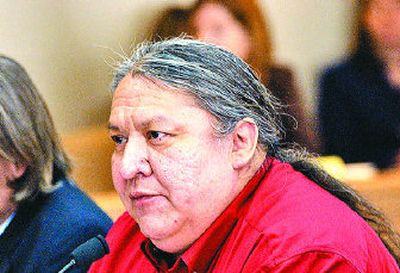
The plan is a sign of a “new and positive relationship” between the state and tribe, tribal secretary Gerald Nicodemus told lawmakers.
Some lawmakers, however, didn’t sound so positive. They say the deal is too generous to the Spokanes, the only remaining gambling tribe in Washington without a state agreement. The state has long maintained that the tribe’s existing slot machines in its casinos in Chewelah and north of Davenport are illegal.
The proposed compact “rewards illegal operations and encourages a tremendous expansion of gambling,” said Sen. Jim Honeyford, R-Sunnyside.
The agreement, if approved by the governor and federal government, would not grant the tribe the right to develop a new casino on part of 145 acres of off-reservation land it owns near Airway Heights. That’s a separate decision that will start with federal officials and include the governor and Spokane County. One lawmaker opined Tuesday that the Spokane Tribe’s odds of winning that rare federal approval are “nil.”
Still, Nicodemus told lawmakers Tuesday, the state compact would help the tribe recover the self-sufficiency once supplied by its 3 million acres of ancestral lands. The gambling envisioned in the compact, he said, would pay for better education for the tribe’s children, better health care for its elders and a diversified reservation economy.
“This compact will be our best chance to impact our tribe’s future in a significant and historic way,” Nicodemus said.
Tribal attorneys, who point out that the state first asked for a state compact back in 1988, say the existing slot machines are and always have been legal.
“Our intent with this compact is to bury the hatchet, not to swing it,” said tribal attorney Scott Crowell.
Since 2005, the tribe and negotiators for the state gambling commission have been hashing out a tentative compact. To take effect, it would have to be approved by the commission and Gov. Chris Gregoire. The state has compacts with 27 of the state’s 29 tribes.
Only a few lawmakers – those who sit on the gambling commission – have a direct say in the process. But even those not on the commission have the governor’s ear.
Under state law, tribes are each allowed to have 675 slot-style machines. Tribes with large casinos typically lease machines from smaller tribes, with a maximum of 1,500 to 2,000 machines at most casinos. The Confederated Tribes of the Colville Reservation, due to their sprawling reservation in sparsely populated north-central Washington, are allowed the most machines: 4,800 at six facilities. Most of those are leased from other tribes.
Tribal gaming is a surging industry in Washington. It now accounts for nearly $1.2 billion of the state’s $1.8 billion in gambling, according to state gambling commission estimates. Tribal casino profits are now more than six times what the state collects from Washington’s lottery, and 12 times what the state gets from pull-tab sales.
Most of that growth has come from the machines, which have mushroomed from about 3,000 in 2001 to about 17,000 today.
“Where does that end?” said Rep. Richard Curtis, R-La Center. In 2004, state voters overwhelmingly shot down an initiative that would have allowed slot-style machines in nontribal businesses like card rooms and bars.
In addition to allowing up to 4,700 machines, the Spokane compact includes some extras that other tribes haven’t gotten. It allows machines that are cash-fed, instead of forcing players to use paper tickets or plastic cards. It allows machines that are played with one button, instead of two. And it allows high-stakes betting at limits set by the tribe.
“I can hear it coming: ‘Look what you did for the Spokanes,’ ” said Sen. Jim Clements, R-Selah, whose district includes the Yakama Tribe.
Sen. Margarita Prentice, D-Renton, said she doesn’t like the high-rollers provision.
“It’s still real troublesome that you can leapfrog over (the other tribes) and have a real juicy plum that other tribes don’t have,” she told tribal members.
Curtis, Prentice and other lawmakers want tribes to be covered by compacts negotiated at the same time, so agreements don’t one-up each other.
Prentice predicted that the tribe’s odds of winning approval for the off-reservation casino are “nil.” She also predicted that other tribes will oppose the Spokanes’ compact. “I think they’ll be really angry – because they are now,” she said.
One tribal elder was clearly offended by the legislative resistance and by how little time was allowed for tribal members to speak.
“I came over here with a good heart,” said Jim Sijohn, who bristled at some of Prentice’s comments.
This is the compact’s second version. In 2005, the tribe and state negotiators settled on an agreement that would have allowed up to 7,500 machines, including 4,000 in a single casino. Some lawmakers balked, and Gregoire ordered the version scrapped.
The next stop for the proposal will be a public hearing before the state gambling commission, slated for Feb. 9 in Olympia. The compact would have to be approved by the commission, the governor, the tribe and the federal government.