
Visitors leave mark at sculpture park
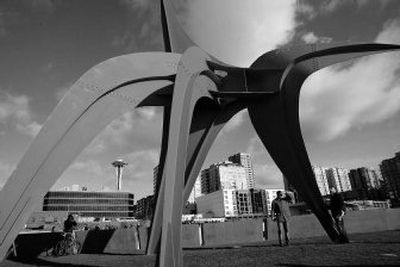

SEATTLE – The Seattle Art Museum’s new Olympic Sculpture Park has attracted more than 40,000 visitors in its first week. And plenty of fingerprints.
Despite signs asking visitors not to touch the artwork – greasy hands can leave marks – the museum’s chief conservator, Nicholas Dorman, has had to power-wash handprints and scuff marks off some of the sculptures.
Richard Serra’s 330-ton steel sculpture “Wake” has attracted the most prints, but the number of marks has decreased since museum workers surrounded it with do-not-touch signs.
“We want to be friendly and positive,” Dorman said, “but we’re encouraging people to think before they touch, as touching art has consequences.”
In some cases, people wrote their names on the corroded surface of Serra’s 14-foot-tall slabs with their fingers: “Vito,” “Cameron” and “Andy,” among others. Some of the marks are still visible despite the power-washings and will have to be buffed out.
“We are at the beginning stages of learning how to take care of the art in the park,” he said.
The $85 million park opened Jan. 20, has free admission, and features views of the Olympic Mountains, Mount Rainier and Puget Sound.
It’s too optimistic to think everyone will keep their hands off the sculptures, said Sarah Clark-Langager, director of the gallery and sculpture park at Western Washington University in Bellingham.
“There’s absolutely nothing you can do about it,” she said. “Some of us come from a museum world, in which the public is not allowed to touch anything. That works inside but not out. We can hope that people learn to treat outdoor sculpture with respect.”
Some of the art is interactive, such as Roy McMakin’s “Bench” and Louise Bourgeois’ six eye benches, not yet installed.
Dorman doesn’t believe SAM is being too fussy about its “no-touch” policy.
The vivid coloring in Serra’s sculpture, for example, is in part due to its lack of a protective coating. The steel has a natural cycle of weathering that will darken to an amber. The oil in human hands alters the corrosive process.
Anthony Caro’s “Riviera” came to the park with a coated surface. Putting one on the Serra would save a lot of work, said Dorman, but the museum wants to present and preserve “Wake” as the artist intended.