
Priorities clash in fuel shop bid
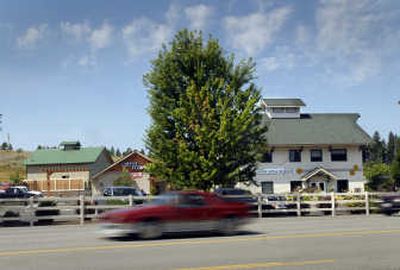
A 23-year-old idea for a gasoline station on Bigelow Gulch Road will go to Spokane County commissioners next month with a new wrinkle and as much opposition as ever.
The county Planning Commission voted 4-0 earlier this month to urge county commissioners to reject a zoning code amendment that would open Orchard Prairie and other rural areas to gasoline convenience stores.
Chattaroy resident Steve Smart proposed the amendment so he could add a gasoline convenience store to the Smart Gardens nursery and other businesses he operates at the corner of Bigelow Gulch and Argonne roads.
Unable to win a zone change, he proposes to change the rules instead.
His proposed zoning-code amendment would allow as many as 10 stores on Bigelow Gulch Road, two on the Palouse Highway, one on Deer Park-Milan Road and one on Trent Avenue at Harvard Road. There could be more in the future on heavily traveled roads.
“We were pleased with the obvious, correct conclusion that the Planning Commission made,” said Lorna St. John, chairwoman of the Prairie Protection Association. “The amendment is not in any way in keeping with the comprehensive plan, and we’re hoping that the county commissioners will concur.”
Orchard Prairie residents formed the association about 1 1/2 years ago to fight a proposal to turn Bigelow Gulch Road into a four-lane highway. Association members believe Smart’s proposal also would degrade their rural lifestyle by encouraging more commercial development.
Smart didn’t respond to several requests for comment.
His land-use consultant, Dwight Hume, told planning commissioners the amendment was needed because changing the comprehensive plan and rezoning an area “takes far too long to be practical.”
Public records show Jerry Widmer, a previous owner of the Smart Gardens site, sought a zone change in 1984 so he could build a store that would sell groceries, hardware, farm supplies and gasoline. County commissioners turned him down unanimously.
A new group of commissioners said conditions hadn’t changed substantially in October 1996 when they unanimously rejected Smart’s 1995 request for a similar zone change to allow a gasoline convenience store.
Smart’s latest request will be heard by three new commissioners: Mark Richard, Todd Mielke and Bonnie Mager.
If that approach doesn’t work, Smart and owners of several neighboring properties want commissioners to extend the Spokane Valley “urban growth area” about a mile north.
That proposal is among numerous comments officials received as part of an ongoing effort to update the county comprehensive land use plan.
St. John disputed Smart’s contention that a gasoline station and store are needed.
“It is only two or three miles to town,” St. John said. “Most of us who live in the country are used to taking care of our gas and grocery needs before we come home for the night.”
The Neighborhood Alliance of Spokane also opposed the zoning code change, but Smart Gardens neighbor Mark Hauschild told county officials he would welcome a convenience store.
Smart already operates a landscaping service, called Environment West, and a florist and espresso shop in addition to his Smart Gardens commercial greenhouse and nursery.
Gasoline convenience stores are singled out for special attention in various commercial and industrial zones because of concerns about environmental contamination, extended hours and heavy traffic.
Rural convenience stores are allowed only in hamlets zoned as “rural activity centers,” and are restricted to 20,000 square feet. The Smart amendment would eliminate the size limit.
Smart Gardens is in a “rural traditional” zone, under which the amendment would allow convenience stores at intersections where one of the roads carries at least 5,000 vehicles per day. Traffic at Bigelow Gulch and Argonne roads currently averages 11,895 vehicles per day.
Various limitations would apply to convenience stores in the rural traditional zone, including a 5,000-square-foot maximum size, and a hearing examiner could attach additional restrictions in the required conditional-use permit.