
Historic gardens revived
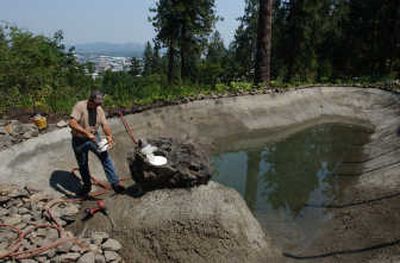

The long-awaited opening of the Moore-Turner Heritage Gardens in Spokane’s Pioneer Park is on track for Aug. 18 after workers finished planting and reconstructing the historic landscape last week.
Tender young plants, selected for historical accuracy, will get a scant three more weeks to spread roots before the opening celebration, which will continue on Saturdays and Sundays through September.
Lynn Mandyke, manager of the project for the city, said the plants are still so small and the garden layout so new that she is afraid that an unlimited opening could result in tender plants and beds being trampled.
“It is important to protect the site,” she said.
Mandyke said staff members and volunteers will be on hand to guide visitors through the newest addition to Spokane’s park system. A series of interpretive signs will add to public understanding of the gardens’ significance.
While the plants are still in their infancy, the landscaping that was resurrected from 75 years of decay is impressive. It sits on a 2.9-acre site with a 120-foot vertical rise, allowing for great views of the city to the northeast. Structures include a rose arbor, pond and waterfall, reflecting pool, upper pergolas, teahouse and well house.
Completion of the gardens comes after nine years of research, planning and fundraising. Virtually no city tax money was used on the $1.4 million project. The work was done with funding from grants and gifts and with volunteer help.
Full reconstruction was made possible through a $1.2 million donation from Myrtle Woldson, a businesswoman and neighbor to the south of the gardens.
“In a couple of years, it will look real good with the plants nice and full,” said Tracy Marko, who has been working on the project for the past three years as an employee of A.M. Landshaper Inc. of Spokane, the main contractor on the job.
The gardens originally were part of private landscaping for an 1889 mansion designed by renowned Spokane architect Kirtland Cutter. But the house was torn down in 1940 and the gardens slowly decayed, only to be rediscovered by Mandyke and others in 1998.
Included on local, state and national historic registers, the site takes its name from pioneers F. Rockwood Moore and his wife. He was the first president of Washington Water Power Co. (now Avista Corp.) and died in 1895.
The second occupants of the house were George Turner and his wife, Bertha, who are credited with major expansion of the gardens.
George Turner, a judge, helped draft the Washington Constitution in 1889 and won a single term in the U.S. Senate in 1897.
In 1903, he greeted President Theodore Roosevelt at the home while the president was on a swing through the West, but Turner was gone from the Senate by then, according to a news story of the visit.
Bertha Turner, who apparently used the gardens to entertain and help further her husband’s career, moved away in 1932 after her husband died. That’s when the gardens began to decline.
She died in 1939, a year before the mansion was removed.
Years earlier, she had donated photographs and other records of the home to Washington State University. Those items became a starting point for research for the reconstruction project.
Mandyke said the gardens obviously were important to Bertha Turner because she took care to give WSU black-and-white photographs of them. Some of those photos were hand-tinted to show garden colors.
Among the photos is one of her seated on a stone staircase beneath a small linden tree. The staircase and tree are still in place today, in part because of painstaking efforts to save the staircase wall from tumbling over in recent years.
Some portions of the gardens were not restored – and were left as piles of ruins or unused walkways – because insufficient photographic evidence has been found of what had been there before, Mandyke said. Historic photos of the gardens still are being sought to help fill in some of the gaps in information about the layout, she said.
Part of the reconstruction involved removing downed timber and overgrowth. As more light penetrated to the ground, plants that apparently were part of the original landscaping began to re-emerge, including lilacs on the upper hillside.
The gardens retain their original balance between man-made landscaping and surrounding woodland. Several large deciduous trees, including a huge poplar, are holdovers from the early years.
In recent months, a pair of nesting peregrine falcons has taken up housekeeping at the garden.
Mandyke credited construction crews for not damaging the historic site with their equipment.
The city Parks and Recreation Department has assigned gardener Tara Newbury as seasonal caretaker.
While much of the gardens reflect the arts-and-crafts influence of the early 1900s, the teahouse on the upper reaches has a distinctly Victorian look with a conical roof, which magnifies the sounds of voices underneath it.
A waterfall at the head of a 70-foot-long pond was upgraded from its original 3/4-inch pipe to 2-inch pipe, giving it a stream of about 60 gallons a minute, said Ken Brangwin, foreman for the project.
Adjacent pergolas were reconstructed to match the structures shown in old photographs. Several original mortared columns were reused in the structures, and the new columns closely match the old ones.
“I tried to leave the mortar out like the original ones,” Brangwin said.
Mandyke said that throughout the years of research and planning, she always believed the gardens would be restored because of their place in Spokane history.
“I really think the Turners would be pleased,” she said.