
Plan offers Israel security
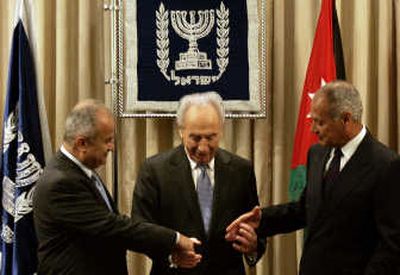
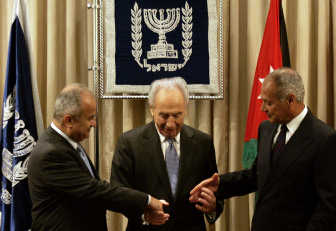
JERUSALEM – In a first, an Arab League delegation came to Jerusalem on Wednesday to promote a plan for peace with Israel, saying it offers the country “security, recognition and acceptance” by its Middle East neighbors.
Such a visit – and offer – once would have been unimaginable, but was greeted now with little public fanfare, pushed well down on the evening TV news by a public sector strike and a row involving Israeli Prime Minister Ehud Olmert.
Led by the foreign ministers of Egypt and Jordan, the Arab delegation was taken deep into Israel’s political heartland. The delegates saw the prime minister and the president and visited parliament, bringing a proposal for full recognition of Israel by the Arab and Islamic world in return for Israel’s withdrawal from all lands captured in the 1967 Middle East war.
While the Israeli and Arab officials greeted each other with smiles, jokes and what looked like genuine warmth, both sides acknowledged that the Arab League peace proposal cannot bypass direct talks between Israel and the Palestinians.
“This serious offer constitutes a major opportunity of historical levels,” Jordanian Foreign Minister Abdul-Ilah Khatib said at a news conference alongside his Israeli and Egyptian counterparts. “It will provide Israel with the security, recognition and acceptance in this region which Israel has long aspired to.”
He said the plan was endorsed not only by the Arab League, but also by non-Arab Muslim states.
Israel has welcomed the proposal as a basis for negotiations but says parts are unacceptable.
After pulling out of the Gaza Strip in 2005, Israel rejects a full withdrawal from the West Bank and east Jerusalem, hoping to retain areas heavily settled by Israelis. And Israel strenuously objects to the plan’s apparent call for the repatriation to Israel of Palestinians who became refugees in the 1948 Mideast war and their descendants – some 4.4 million people, according to the United Nations.
Israeli Foreign Minister Tzipi Livni said the way forward was to look for points of agreement between Israel and the Arab world while seeking a bilateral solution to core issues such as the refugees and the status of Jerusalem.
“I think it would be a mistake today … to start arguing about every clause” of the plan, she said, pointing out that its central tenet, formation of an independent Palestinian state living in peace next to Israel, was shared by the Israeli government and moderate Arab states.
“We are not being asked to negotiate on behalf of the Palestinians,” Egyptian Foreign Minister Ahmed Aboul Gheit said. “We will be helping both the Palestinians and the Israelis to negotiate among themselves.”