
TT a splendid all-around sports car
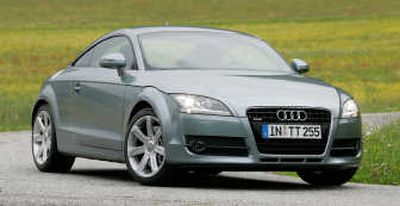
Imagine the anxiety Audi designers felt embarking on the redesign of the TT.
Like Michelangelo being told he had to improve upon the David, I imagine. Or Shakespeare being sent back to rewrite King Lear.
So powerful and distinctive was the original it was instantly hailed as a classic.
Its graceful proportions and fluid lines paid homage to early Porsche design. Post-Industrial touches – exposed bolt-heads, anyone? – added an eccentric European edge.
The car made a clean break with everything immediately preceding it and set automotive design off on a new course.
Most important, it has worn well over the years.
Still, it has been decreed that automotive design must move forward. GM’s Alfred Sloan declared it so in 1924, when he invented the strategy of annual design updates.
He called it “dynamic obsolescence.”
It’s why you get that itch every 30 months or so to buy a new car.
Deeper than Skin
As daunting as the redesign task must have been, the TT changes in ways that go deeper than new sheet metal.
The 2008 edition is five inches longer and the wheelbase has grown by two inches. The car is both wider and taller, by small margins, and has a wider track and a lower center of gravity.
Extensive use of aluminum in the chassis makes the new TT lighter and more rigid. Revised suspension and steering systems increase performance levels at the edge of the envelope.
The power choices remain the same. The base TT Coupe (from $35,575, including destination) is driven by a turbocharged, 2.0-liter four-cylinder engine rated at 200 horsepower; the uplevel, all-wheel-drive 3.2 TT Quattro ($42,275) gets a 3.2-liter V-6 good for 250 hp.
Convertible versions are available for both editions and fetch a premium ranging from $2,000 to $3,000, depending on the model.
Audi’s groundbreaking dual-clutch transmission, renamed this year to S tronic, is back as an option. A six-speed stick is standard.
A handful of minor changes update the interior. Most noticeably, the TT has adopted the flat-bottom steering wheel of the R8 supercar, the deeply bolstered seats sit lower in the cabin and a fourth circular vent has been added to the dash.
Missing in action are the angular struts that visually tied the dash to the center console in the original. A brilliant design concept, they annoyed long-legged drivers, whose knees grew sore rubbing against them over long distances.
The “2+2” rear seats are more afterthought than a useful place to sit. The small children who are likely to sit back there will most likely be put off by the lack of a view; one rides deep in this cockpit, as in those early Porsches.
Re-design by Increments
There must have been debate at Audi over how sharp a break to make from the original TT design.
If so, the moderates won out. The changes are so well integrated into the essential shape many casual observers won’t notice them. Front and rear overhangs still flow tautly around deep drawn wheel wells and the low greenhouse continues to convey a feeling of compact strength.
In the most apparent departure, the roofline now flows more organically into the stubby hatch. Audi’s single-frame radiator grille now dominates the front, while the slender, sloping headlights are more sharply defined and the air inlets larger.
The overall look is somehow more masculine, while also appearing sleeker.
How it Comes Together
The TT competes most directly against a pair of exceptional German sports cars – the Porsche Boxster and BMW Z4 – and one from Japan, Nissan’s 350Z. All use traditional rear-drive layouts and, predictably, and predictably are sharper in the turns than the front-heavy TT.
Due in large part to its increased rigidity, the TT comes across as more high-strung than the easy-going first edition. The tendency is most noticeable on broken pavement.
Faced with a rough surface in the apex of a fast corner, the TT seems to shift its weight to the outer wheels with a slight but disconcerting lift
A new electrically assisted, speed-sensitive steering system is more precise than the one it replaces, but is less communicative than those found on the competition, again owing to the location of the drive wheels.
Still, the TT is a splendid all-around sports car. It’s nimble and responsive and the six-cylinder engine packs a serious wallop. Some drivers – and I suspect I would be one of them – find the four-cylinder more rewarding, due largely to its lighter front end. In either case the TT will outstrip the abilities of almost everyone who will drive it.
As much as I like this car, though, I surprised myself by choosing a competitor’s model – albeit a larger and more expensive one – for a long distance trip. The TT is a lovely sprint car, a less attractive Grand Tourer.
In the end, it may offer the most appealing combination of styling, engineering and sophistication in its class. Had Michelangelo refashioned his masterpiece, he would have been pleased to have him turn out as well.