
A bright, if warmer, future
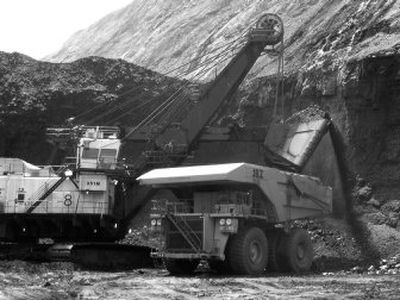
WRIGHT, Wyo. – Every second of every day the oversized shovels of the Black Thunder mine claw another three tons of coal from the arid plains of eastern Wyoming.
Sprawled across 20,000 acres, Black Thunder produces more coal than any mine in the Western Hemisphere. America’s thirst for the fuel it provides is larger still: more than 1.1 billion tons consumed in 2006, or almost four tons per person.
But after years of steady growth, spurred by the rising cost of coal’s main competitor, natural gas, the industry faces an increasingly uncertain future.
Each ton of coal burned emits more than two tons of carbon dioxide, the prime contributor to global warming. Environmentalists and some policymakers are calling for the country to wean itself from coal by investing in wind, biofuels and other energies, and levying new taxes on carbon emissions. In the interim, they want mandates for cleaner power plants.
Yet coal could prove a habit hard to break.
Companies like Arch Coal, owner of Black Thunder, supply the fuel for more than half the country’s electricity. And with the industry’s backing, Capitol Hill lawmakers led by Sen. Craig Thomas, R-Wyo., and House Natural Resources Committee Chairman Nick Rahall, D-W.Va., have been pushing to recast coal’s image – from climate change culprit to promising “alternative fuel” that could ease dependence on foreign oil and possibly provide an exit plan for the global warming quandary. (Thomas died late Monday, according to the senator’s family. He had been receiving treatment for leukemia.)
Think of it as diet coal: A new wave of coal-fired power plants would capture carbon dioxide to prevent its release into the atmosphere. Other plants would use a process to convert the black rock into diesel or jet fuel, to reduce imports of foreign oil.
Both technologies remain untested in the United States on a wide commercial scale. Thomas said that’s why the government needs to step in and spur their development through loans to industry and a mandate for 21 billion gallons a year of coal-derived liquid fuels by 2022.
But a neighbor to the north, Democratic Sen. Jon Tester of Montana, is saying coal should not expect a free ride, that any coal-to-liquids plant supported by federal dollars must include technology to capture and store carbon. The plants are projected to cost billions of dollars, making federal backing key to moving forward.
Still, from the vantage of the Black Thunder mine, it is hard to imagine coal’s future dimming anytime soon.
The mine is one of more than a dozen along the eastern edge of the Powder River coal seam, which accounts for about 40 percent of the nation’s coal production.
“In front of us are millions and millions and billions of tons of coal,” said Arch Coal Vice President Greg Schaefer. “There is 200 years worth of coal here at present consumption. It’s an incredible resource.”
The Department of Energy forecasts coal’s share of the energy market will increase to almost 60 percent over the next 25 years. Unless cleaner technologies are adopted to lower carbon emissions, that will spur an environmental “catastrophe,” said David Hawkins, director of the climate center at the Natural Resources Defense Council and a former senior official at the Environmental Protection Agency.
Yet to replace 90 gigawatts of additional electricity – the amount the Department of Energy says will come from 151 new or proposed coal power plants – would require 60,000 wind turbines or 100 mid-sized nuclear plants.
“There’s just nothing that comes in at the scale of coal over the foreseeable future,” said James Bartis, a RAND Corporation researcher specializing in energy issues.
But Hawkins said that argument should not be extended to coal-to-liquids, which he described as a worse polluter than conventional fuels. He said it would take up to 250 million tons of additional coal production every year to reach Thomas’ 21 billion gallon annual mandate.
In the last three years, lobbying expenses by the coal industry more than tripled, from $2 million in 2004 to almost $7 million last year, according to the nonpartisan Center for Responsive Politics. What that means for coal production, and the steady march of the Black Thunder Mine across eastern Wyoming, could be decided by Congress in coming weeks.
“Over the next 20 years, the question is not whether the industry will go down,” said Bartis. “It’s how much will it go up.”