
Bush downplays rhetoric between himself, Putin
HEILIGENDAMM, Germany – President Bush and Russian President Vladimir Putin, after trading criticism and sniping from afar, sit down privately today for some difficult talks about their differences. Likely to be a tense meeting?
“Could be,” Bush said Wednesday.
“I don’t think so, though,” Bush hastened to add. “I’ll work to see that it’s not a tense meeting.”
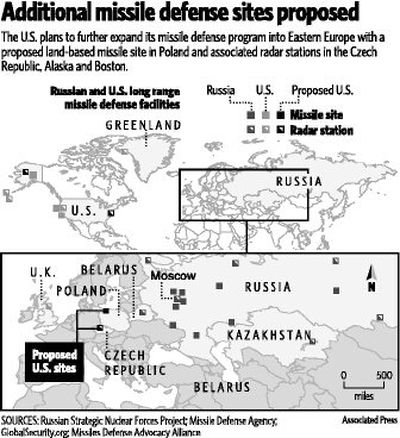
Putin spokesman Dmitri Peskov, likewise, tried to turn down the temperature. He said arguments are part of a constructive relationship, even as he reiterated disagreements with U.S. views of Russian democracy and dissatisfaction with explanations about a U.S missile shield in Europe.
Bush tried to halt the steep slide in relations with Putin by saying Russia is not a menace to Europe despite a threat to aim missiles at the West.
“Russia is not going to attack Europe,” the president said, brushing off Putin’s warning that he would reposition Russian rockets in retaliation for an American-devised missile shield to be based in Poland and the Czech Republic.
“Russia is not an enemy,” Bush emphasized. “There needs to be no military response because we’re not at war with Russia.”
Bush appeared eager to call a time-out in the bickering over everything from criticism about Russia’s backslide on democracy to Putin’s complaints about U.S.-backed independence for Kosovo and a supposed new arms race triggered by Washington.
“There will be disagreements,” the president said, relaxing in the sun during an interview with a handful of reporters before the annual summit of major industrialized countries. “That’s just the way life works. But that doesn’t necessarily lend itself to speculation that somehow the relationship between me and the president (Putin) is not a positive relationship. It is a positive – and I’m going to work to keep it that way.”
Bush sat for the interview just hours before the opening of the Group of Eight summit with Germany, Canada, Britain, France, Italy, Japan, the United States and Russia.
The leaders gathered in Heiligendamm, a Baltic Sea town in northern Germany that was circled by seven miles of razor wire-topped fence.
Thousands of demonstrators blocked roads to the summit site, and thousands more streamed toward the fence. Police used water cannons to scatter stone-throwing protesters.
At a pre-summit lunch, Bush discussed combating global warming and poverty in Africa with German Chancellor Angela Merkel, the summit host. She advocates a tougher stand on climate change than Bush.
Merkel said they had a “very good debate … but I trust that we will work out joint positions.”
In the interview, Bush said he would not yield to Merkel’s proposals for mandatory caps on greenhouse gas emissions. Bush has countered with a plan for negotiations among the United States and other nations that spew the most greenhouse gases – including China and India – to set a long-term strategy by the end of next year for reducing emissions. U.S. officials said Bush was willing to move more quickly to set goals.
In the interview, Bush offered his case for why Russia should not worry about a U.S. missile shield in Europe.
The shield could defend against only one or two rocket launchers, Bush said. “Russia has got an inventory that could overpower any missile defense system,” he said. “The practicality is that this is aimed at a country like Iran, if they ended up with a nuclear weapon, so that they couldn’t blackmail the free world.”