
Preserving Pleasantview

POST FALLS – Nearly 100 years ago, the peal of the Pleasantview School bell called children to the schoolhouse, outfitted with rows of wooden and wrought-iron desks and classrooms lined with chalkboards.
The Pleasantview Community Association hopes to bring back those days and preserve them for posterity.
Since 2000, when the group began work on the schoolhouse’s classrooms, volunteers have hammered, sawed and painted the two-story stucco and brick building into a more solid standing.
“Before, it looked abandoned,” said Bob Ickes, president of the Pleasantview Community Association, which has a few dozen members.
In the last seven years, the association has volunteered thousands of hours and gathered more than $40,000 in donations and grants to help restore the nearly century-old structure, Ickes said.
The group even tracked down the original 800-pound cast-iron bell that had been stolen years ago as a high school prank.
The Pleasantview School, dedicated in 1910 and tucked in the hills south of the Spokane River, is one of the oldest schools in the area, said Kim Brown, chairwoman of the Kootenai County Historic Preservation Commission.
She commends the Pleasantview association for its dedication to restoring the school.
“It’s not just a bunch of folks getting together and saying let’s fix up the place. …It’s (a) whole community effort,” Brown said. “It’s really paying off.”
And it’s attracting statewide notice.
Last month, the association won an “orchid” heritage stewardship award from the Idaho Historic Preservation Council for the continual maintenance and care of the school.
“It’s a testament to the perseverance and the faith people had in the long-term commitment” to restore the school, said Brown, who nominated the group. “It’s a symbol of community and a symbol of working together.”
The school, which was part of the Pleasantview District and included grades one through 12, operated until spring 1937. Three years later, it was consolidated with the Post Falls School District.
The building remained a center for community activities, but over the years, it fell into disrepair.
In the early 1970s, the Pleasantview Community Association formed and in 1985 worked to have the school placed on the national historic registry.
In 2000, the association decided to tackle the second floor of the building, which housed two classrooms and cloakrooms. The first floor, where the teacher’s quarters and a boiler room previously were located, had been turned into a kitchen and meeting room in the 1970s, Ickes said.
The upstairs, though, had been relatively untouched, except for the animals and birds that had found ways inside and the decades of dust that had piled up, Ickes said.
The group reinforced the roof, replaced windows and discovered original desks tucked away in the attic.
Years ago, high school kids hauled away the heavy school bell as a joke. It became the touchdown bell at football games, painted hunter orange for the Post Falls Trojans.
Ickes, a former Post Falls School Board member, tracked it down behind the school district’s maintenance shed, along with the bell’s original clapper – which Post Falls schools Superintendent Jerry Keane unearthed in his garage, Ickes said.
The association sandblasted the bell, built a new frame and mounted it again in the belfry.
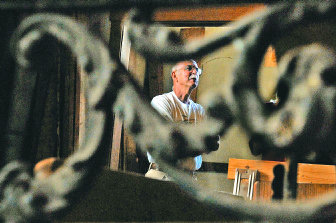
“I like ringing the bell,” Ickes, 64, said last week as he yanked on the bell’s long rope. It could be heard from miles around. “I’m sort of the official bell-ringer.”
This summer, the group is redoing the school’s concrete front stairs and planning more work to reinforce the structure and repair large cracks spreading along the walls.
Someday, Ickes said, he’d like to see students holding all-day classes in a restored period classroom, complete with the rows of ink-stained original desks. The second classroom could be transformed into a miniature museum with displays from the past or a spot for receptions and gatherings, he said.
“I think it’s kind of neat (for students to see) how probably their … grandfathers went to school and learned, what conditions were like then,” Ickes said.