
Putin suggests missile cooperation
HEILIGENDAMM, Germany – Russian President Vladimir Putin proposed on Thursday that an existing missile-defense radar system in Azerbaijan be used to protect Europe from a possible future attack from Iran, and President Bush said the United States and Russia would begin talks to find areas of potential strategic cooperation.
The surprise proposal from Putin, and the reaction from Bush and other American officials, suggested the two leaders were seeking ways to step back from their heightening confrontation over a U.S. plan to deploy a missile defense network in Poland and the Czech Republic. Before Putin’s proposal, U.S. officials had been preparing for a confrontational meeting with the Russian leader.
Bush did not immediately accept Putin’s offer but said that Putin “made some interesting suggestions.” Bush’s national security adviser, Stephen Hadley, characterized Putin’s idea as “bold” and “interesting.”
Putin made his pitch at an approximately 45-minute meeting with Bush during a break in the Group of Eight summit of the world’s leading industrialized nations, on the sun-dappled grounds of this resort on the Baltic Sea.
Amid a series of demonstrations and the otherwise substantive business of the summit on issues including global warming, Putin’s offer to cooperate on an anti-missile program and Bush’s announcement that each would send top military figures and diplomats to what he called “a serious set of strategic discussions” overshadowed other developments.
Bush said he expected the forthcoming talks to produce “better understanding of the technologies involved” in the proposed missile defense weapons and to increase opportunities to work together.
Bush has insisted that interceptors he has planned to deploy in Poland and the radar units destined for the Czech Republic were intended to thwart possible future long-range missiles from Iran. The two-nation system would comprise the third site for Washington’s global missile-defense system; the other two, still being tested, are in central California and Alaska and are meant to defend against a possible attack from North Korea.
Iran has medium-range missiles but is believed to be trying to develop long-range weapons capable of reaching targets beyond the Middle East. The United States says Iran is also trying to develop a nuclear weapon.
Putin has insisted that the Bush proposal could serve as a threat to Russia and would lead him to retarget Russian missiles at Europe.
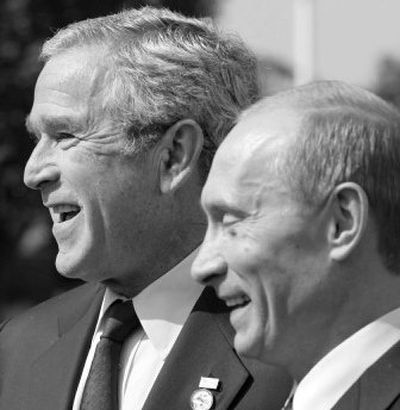
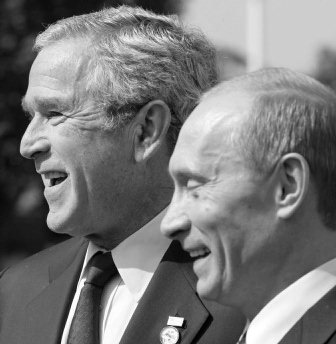
As a steward of a relationship that only hours earlier had seemed to be slipping into a Cold War tenor, Bush appeared relaxed, and smiled frequently while Putin spoke to reporters. Referring to their next planned meeting at the Bush family compound, Bush said: “I told Vladimir we’re looking forward to having him up to my folks’ place in Maine the beginning July.”
Putin said he had proposed to Bush that rather than deploy an entirely new system, the U.S. rely instead on “the radar station rented by us in Azerbaijan.”
Putin said the system, using the Azeri units, would protect all of Europe, rather than just part of Europe as the one planned in the Czech Republic by the United States.
The Azeri radar is one of the largest in the world. It is believed capable of detecting missiles launched over a wide swath of the earth by scanning all of the Indian Ocean, the Middle East and most of North Africa.
Operation of such a joint system would make it “unnecessary for us to place our offensive complexes along the borders with Europe,” Putin said.
Surprised U.S. officials huddled several minutes after the two leaders spoke before discussing it with reporters.
Uncertain how the Azerbaijan system would fit in with the U.S. plan, Hadley said, “We’re all going to have to see.”