
Blast sends message
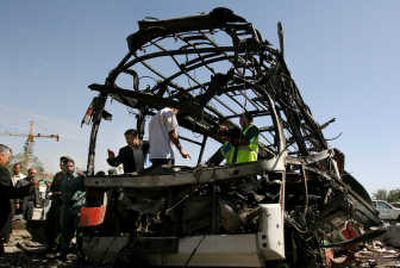

KABUL, Afghanistan – The Taliban claimed responsibility Sunday for the country’s worst bombing since the group fell from power more than five years ago, raising fears of a major escalation in the use of tactics employed to deadly effect by the insurgency in Iraq.
Thirty-five people, many of them police recruits, were killed when a massive explosion tore through a police academy bus in the Afghan capital during the Sunday morning rush hour. At least 35 people were injured.
The blast could be heard miles away and produced scenes of carnage more familiar in Baghdad than Kabul.
Authorities were trying to determine whether the bomb had been planted on the bus or detonated by a suicide attacker. There were reports the bomber may have jumped onto the bus as it stopped at a busy station in the central city.
Since Friday, at least four suicide attacks have struck different parts of the country, including one in the capital Saturday.
The scale of Sunday’s bombing eclipsed anything Afghanistan had seen since the Taliban was driven out by U.S.-led allied forces in December 2001. A car bombing in Kabul in September 2002 killed 30 people.
“It was a very, very successful suicide attack,” a Taliban commander, Mullah Hayatullah Khan, told Reuters news agency by satellite phone Sunday. “We have plans for more successful attacks in future.”
The fundamentalist Islamic group’s claim of responsibility for the blast could not be independently verified, but such attacks increasingly have become a favored Taliban tactic. In March, senior Taliban commander Mullah Dadullah warned in an interview with British television that fighters were prepared to unleash a wave of suicide attacks on international troops.
“The suicide martyrs, those willing to blow themselves up, are countless,” declared Dadullah, who was killed in a May clash with American and allied troops in southern Afghanistan.
Within weeks of Dadullah’s statement, Afghan television began airing news reports of suspected suicide bombers being picked up by authorities in Kabul and elsewhere.
Striking Kabul in spectacular fashion Sunday, a workday in Afghanistan, is likely to have a psychological as well as military impact. U.S. and NATO forces have worked hard to maintain Kabul as an oasis of relative calm, shielded from the conflict gripping other parts of the country, mainly the south and east, where Taliban militants have been most resurgent.
Throughout last winter, allied commanders warned of a looming offensive by the Taliban during the spring thaw, a period which analysts and officials said could be the tipping point between an Afghanistan on the path of peaceful reconstruction and one in danger of lapsing into bloodshed.
Over the past few months, coalition forces have gone on the offensive in contested areas such as the southern province of Helmand, resulting in frequent clashes with Taliban fighters.
On a visit to Kabul two weeks ago, U.S. Defense Secretary Robert M. Gates said things were “slowly, cautiously headed in the right direction.”
But recent events suggest the Taliban may be modifying their strategy, away from larger-scale confrontations on the battlefield to roadside bombs and suicide attacks of the kind that have stymied the United States in Iraq.
The bomb that exploded in Kabul about 8 a.m. Sunday ripped off the roof of the bus and left it a smoking ruin of twisted metal from which police began pulling body after body.
“Never in my life have I heard such a sound,” a vendor named Ali Jawad told the Associated Press. “A big fireball followed. I saw blood and a decapitated man thrown out of the bus.”