
A decade on, Hong Kong hangs on to its identity
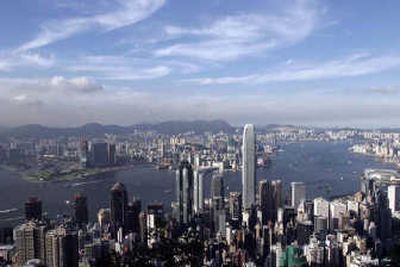
HONG KONG – A decade after Hong Kong returned to China’s control, the steamy tropical air of this money-churning enclave has grown more polluted. Residents exercise outdoors at their peril, and during the latest spring marathon, thousands of runners were left gasping for medical treatment.
On city streets, the singsongy Mandarin Chinese spoken by millions of visitors from the mainland is intruding now on the guttural local Cantonese dialect.
But in most other regards, it’s business as usual, and in some ways it’s better than ever. Hong Kong’s economy is firing on all cylinders, churning out new millionaires and even billionaires.
Last month, with the stock market listing of a leading footwear company, Belle International, two people joined Hong Kong’s list of 21 billionaires. Some 67,000 people – 1 in about every 100 – are millionaires.
Its stock market sells more shares of newly listed companies than the New York Stock Exchange. Workers keep erecting impossibly tall buildings along Hong Kong’s harbor.
Most experts agree that China has largely stuck to its “hands off” pledge for the former British colony, allowing the territory to retain its separate laws, currency and way of life.
Before the 1997 handover, uncertainty gripped the territory, sparking an exodus of hundreds of thousands of residents. Fortune magazine forecast “The Death of Hong Kong” on its cover. Yet questions about the city’s vitality slowly dissipated.
“The biggest surprise is that Hong Kong has done pretty well,” said David Zweig, a political scientist at Hong Kong University of Science and Technology.
Chinese President Hu Jintao and other senior leaders will arrive for the July 1 handover commemorations, with some 400 events and cultural shows in the surrounding period. The underlying message: Anything the British did, we Chinese can do as well.
British officials, who requested an invitation, were politely told that the festivities would be “different in nature” from those of 1997, when Prince Charles presided.
The British imprint, after 156 years of colonial rule, remains on the city, from the double-decker buses to the white wigs that judges don in court. Before the handover, China agreed to a “one country, two systems” arrangement in which it promised not to tamper with Hong Kong’s laissez-faire economy and common-law system for 50 years. Only defense and foreign policy are exempt from the autonomy pledge.
“We can truly say that the implementation of ‘one country, two systems’ has been a success,” the dapper, bow tie-wearing chief executive, Donald Tsang, told Hong Kong’s 6.9 million people in a broadcast last week.
In some ways, China’s oversight of Hong Kong has remained invisible. After the 1989 Tiananmen uprising, when China’s military crushed a pro-democracy movement, many in Hong Kong feared that they’d see Chinese soldiers in their midst. That hasn’t happened.
“There are no tanks, no army, no military people in the streets. The only time we see them is when they open the barracks and invite people in,” said Jeffrey Lam, a member of the territory’s parliament, or Legislative Council.
Free speech is protected. Residents often see banners on city streets condemning China’s ruling Communist Party. Demonstrations by Falun Gong, which Beijing labels an “evil cult,” occur routinely.
Yet China’s influence is noticeable to the eye and ear. Mainlanders have poured into Hong Kong since 2003, when Beijing relaxed travel rules after the devastating SARS viral epidemic whacked Hong Kong’s economy. Last year, 13.6 million mainlanders came to Hong Kong, half of its tourists.
Economic and social integration is increasing.
In 1997, Hong Kong had one rail and two road connections to the mainland; now it’s two rail and four road connections.
Hong Kong factory owners employ some 11 million people on the mainland.
Throbbing industrial activity in the Pearl River Delta region across the border is one reason that Hong Kong’s air has gone bad. The rising pollution is affecting recruitment efforts by Western companies with offices here.
The major gripe that some Hong Kong residents have with Beijing is the lack of a clear timetable for full democracy, which the British also denied them.
In 2003 and 2004 as many as half a million people poured into city streets to demand transition to universal suffrage and full-scale direct elections.
An 800-member, Beijing-backed committee chooses the territory’s chief executive, and only half the 60 members of the Legislative Council are directly elected.