
Avoiding the Blue Creek blues
Blue Creek Bay is like family to Jack Forest.
He knows it intimately: the prevailing winds, the critters that roam, and the stories of the humans who used its plentiful offerings of timber, wild game and water.
To Forest, he never owned the bay, meadows and steep hillsides offering million-dollar views. He was a caretaker, just like his father and the Molstead family that bought the land in 1900 from Northern Pacific Railway Co.
Now the 70-year-old businessman has given that job to the U.S. Bureau of Land Management, which is asking the public how to use the 736 acres, including thousands of feet of public shoreline on Lake Coeur d’Alene.
It’s a key piece of land, opening public access on the lakeshore that is by most calculations about 96 percent private. And it’s just miles from downtown Coeur d’Alene.
Forest, whom BLM officials respectfully call the “Godfather of Blue Creek Bay,” hopes the federal agency doesn’t change much other than allowing hiking, some camping and maybe a dock for kayaks and small boats that fit on car tops.
“It’s nice to have something on the lake that looks like Idaho,” Forest said last week while giving a tour of the land the BLM acquired in chunks between 1991 and 2003.
But he also wants some public use. That’s why he chose to sell his portion of the property – about 610 acres – to the federal government. DAW Forest Products and Idaho Forest Industries traded and donated the remaining acreage.
“I could have sold it for a lot, lot, lot more than I did if I wanted to subdivide it,” said Forest, who still owns three waterfront lots where a family cabin sits, in addition to other property in the area. “There’s a place for everything. This is not the place.”
On June 12, about 30 people attended the first public meeting on how to use the property, which BLM Field Manager Eric Thomson said has the most diversity of any of the agency’s properties in Idaho’s five northern counties. Wetlands, forest, wildlife, waterfront and recreation opportunities all are present, as are segments of historic Mullan Road – the first engineered road west of the Mississippi, connecting the Great Plains to the Northwest.
“Everybody is concerned about us loving that piece of property to death – overdeveloping it and overusing it,” Thomson said.
During the next seven months, the agency will have more public meetings and talks with user groups, from boaters to horseback riders, before making a final decision on the best use.
The BLM will have a public field tour July 21, then will draft alternative plans for the public to comment on at a Sept. 24 meeting.
Gayne Clifford, who has lived in Blue Creek Bay all his life, likes the BLM’s approach. “They are getting people’s input, not just ramming it down people’s throat,” Clifford said.
He and his neighbors are protective of the narrow inlet near Higgens Point that’s crossed by Interstate 90. They don’t want too much congestion in the bay.
Although much of the land has been public for years, the BLM never broadcast its accessibility, so few know about Blue Creek Bay and its surrounding hills. Nor its overgrown logging roads that are perfect for hiking, bird-watching and perusing wildflowers.
The BLM has an old wooden dock, missing a few planks, on the east side of the bay – a spot known as the landing. It’s where loggers hauled millions of board feet of white pine from the nearby mountains and dropped logs into the bay, bundling them for the float to waiting mills on the Spokane River. A few pilings remain – one of the few remnants of Lake Coeur d’Alene’s working history.
Some overnight camping is allowed, but no fires.
When Forest sold the first 300 acres to the BLM in 1995, he reduced the price by about $500,000 to make it easier for the agency to come up with the cash. The BLM bought the land with money from the federal Land and Conservation Fund.
In trade, the BLM designated it a conservation area, prohibiting firearms and motorized vehicles such as dirt bikes and ATVs. The property was named the “Wallace L. Forest Conservation Area” after Forest’s father, who died in 1982.
Wally Forest was raised in Minnesota and became a hobo during the Depression until the rails brought him to Spokane, where he met a farm family from the Mica Flats area near Coeur d’Alene. The farmer’s daughter became his wife, and Wally Forest found work as a Coeur d’Alene police officer, then an Idaho State Police trooper. In 1943, he started Forest Brothers Auto Wrecking, now a steel business known as Forest Steel and owned by Jack Forest’s son.
Wally Forest began buying the Blue Creek Bay property from the Molstead family in the 1950s. The Molsteads paid the railroad $1,100 for the land in 1900. Before the highway came, the Molstead family operated two boats to haul freight and passengers, and a post office and small store in the bay.
Jack Forest keeps a briefcase full of historic documents and photos, including the deed transfer between the railroad and Adolph Molstead. Black-and-white photos show the bay long before the Avista dam changed its shoreline and the bare hillsides a few years after the 1910 fire ripped through the property.
Wally Forest hayed the meadow by the bay and pastured cows and horses on the rest.
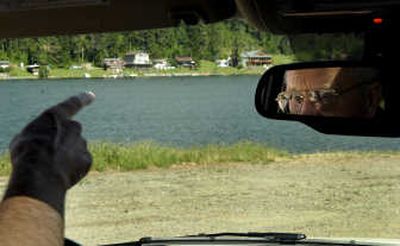
While driving along Yellowstone Trail Road last week, Jack Forest stopped his Cadillac to point out the barbed-wire fence, held together with 3,000 railroad ties, that his father planted mostly by himself.
Every time Wally Forest cut trees, he planted a grass seed mix. He left brushy areas for the deer to hide. Today a herd of elk winters nearby. Moose, deer, bear and wild turkeys are common sights.
When Jack Forest spied a doe hiding in the grass, he gently whistled out the window as if greeting an old neighbor. Forest, who lives downtown, comes to the property most days. He mows the grass on the property he still owns. But mostly he sits still, listening and watching the wild.
“The government could take lessons from my father,” Forest said about its logging and management practices.
Selling only 300 acres at first was Forest’s way of testing the BLM before he parted with all the property. He wanted to see the stewardship. He was impressed enough to finish the deal with another 300 acres. But he’s not done testing.
“I’m keeping an eye on them,” Forest said.
He wants no credit for his involvement, which some people see as a gift. He thinks his dad was the true steward. The Forests never specifically talked about how to manage or preserve the land. It was “Conservation is just common sense,” Forest said. “It doesn’t mean tree-hugger.”