
Wheels are turning on plan to revive a bit of history

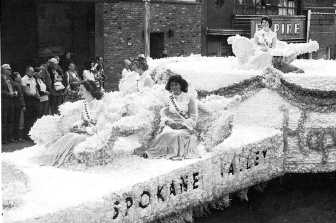
When a program from the Spokane Valley’s 1976 Fall Festival arrived at The Spokesman-Review’s Valley office late last week, it was like someone set the way-back machine to the community’s salad days.
The now departed Fall Festival was a nine-day celebration orchestrated by the Spokane Valley Chamber of Commerce. Car shows and belly dancers, folk singers and oompa bands stomped out the rhythm of Spokane Valley life on stages pitched in parking lots from Argonne to South Greenacres.
It was a time when Sprague Avenue seemed more like a bloodline to Spokane Valley prosperity rather than the varicose vein, as some now see it, shuttling thousands of cars east and west but only rarely delivering them to the parking lots of businesses, which have gone numb from lack of circulation.
Nine days of ice cream socials and fencing demonstrations, powder puff football games and dunk tanks. A person could pig out on cotton candy, cobbed corn, root beer floats and Jaycee barbecued chicken, and then risk it all, spinning like a roulette marble on the lariat ride at the Argonne Center carnival.
The showstopper was the parade. In 1976 the Fall Festival Grand Parade had 116 entries, including more than 33 royalty floats from communities across the state. Twenty Miss this-and-thats, 56 princesses, none more stylish than the girls of Spokane Valley, who rode down the street on what can only be described as a giant wedding cake. “Miss” Kay Kenney, princesses Colleen Henderson, Joan Brookbank and Sue Monville, cruising the drag in chiffon gowns and hairdos parted down the middle winged on the sides – think “Charlie’s Angels” with a little Barbara Cooper from “One Day at a Time” thrown in for moderation.
How badly does Spokane Valley yearn for those days? The city has spent a cool half-million trying to come up with a plan to revive Sprague Avenue. The main focus of those efforts includes a town center just east of U-City Mall. U-City, which sizzled with commerce in 1976, was ground zero for the Fall Festival. The mall sits half-empty today; its original indoor retail shops have been shuttered for more than a decade.
Valleyfest, which started in 1990 as a fair to promote social services offered by area nonprofits, has taken on Fall Festival proportions, growing in attendance from a mere 4,000 to roughly 40,000, and largely shoulders the city’s need for community entertainment.
The missing piece to the puzzle might be a Spokane Valley float. In recent years, volunteers have brought back the parade and energized the community’s only festival but just haven’t been able to pull the trigger on plans to launch a Valley float.
Exit 289 wrote about the Valley’s float conundrum in April, after the Chamber of Commerce crowned a new batch of girls royalty for a year but had no float on which to put them.
The column stirred some activism. Someone stepped forward with a 1994 Dodge minivan ideal for powering a petal-covered barge. A car club offered to do the welding. An engineering firm volunteered to work in the hydraulics needed to animate the float, which organizers think could be 16 feet long.
Last week, the board of directors for Valleyfest voted to take the float under its wing and appoint someone to shepherd the project along. The only thing that slowed the float’s progress was the Spokane Valley City Council’s rejection of a request to contribute $6,500 to the float’s construction costs.
Float promoters thought their project might qualify for tourism promotion funding. The city receives a percentage of the sales taxes collected on motel rooms for tourism promotion. By law, the money is supposed to be spent on things that bring people from outside the area into Spokane Valley. “Outside” can mean as nearby as Liberty Lake, Post Falls or even Spokane.
The float didn’t make the cut. A lot of things didn’t. After two rounds of selecting projects worthy of bed tax money, Spokane Valley still has $250,000 in the bank. It is encouraging float organizers to reapply later this year, presumably because it believes the float has merit, both as a community calling card traveling through festivals throughout the state and as a way to lure people to Spokane Valley. Among the festival set, there’s a tacit understanding that anyone who sends a float to a community’s parade will be rewarded in kind.
The float might be a way to recapture some of that 1976 Fall Festival magic. It may be the most affordable option yet to a way-back machine.