
Bush calls al-Qaida top threat in Iraq
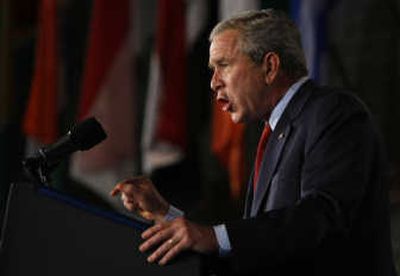
WASHINGTON – Facing eroding support for his Iraq policy, even among Republicans, President Bush on Thursday called al-Qaida “the main enemy” in Iraq, an assertion rejected by his administration’s senior intelligence analysts.
The reference, in a major speech at the Naval War College that referred to al-Qaida at least 27 times, seemed calculated to use lingering outrage over the terrorist attacks of Sept. 11, 2001, to bolster support for the current buildup of U.S. troops in Iraq, despite evidence that sending more troops hasn’t reduced the violence or sped Iraqi government action on key issues.
Bush called al-Qaida in Iraq the perpetrator of the worst violence racking that country and said it was the same group that had carried out the Sept. 11 attacks in New York and Washington.
“Al-Qaida is the main enemy for Shia, Sunni and Kurds alike,” Bush asserted. “Al-Qaida’s responsible for the most sensational killings in Iraq. They’re responsible for the sensational killings on U.S. soil.”
U.S. military and intelligence officials, however, say that Iraqis with ties to al-Qaida are only a small fraction of the threat to American troops. The group known as al-Qaida in Iraq didn’t exist before the U.S.-led invasion in 2003, didn’t pledge its loyalty to al-Qaida leader Osama bin Laden until October 2004 and isn’t controlled by bin Laden or his top aides.
Bush’s references to al-Qaida came just days after Republican Sens. Richard Lugar of Indiana, the top Republican on the Senate Foreign Relations Committee, and George Voinovich of Ohio broke with Bush over his Iraq strategy and joined calls to begin an American withdrawal.
“The only way they think they can rally people is by blaming al-Qaida,” said Vincent Cannistraro, a former chief of the CIA’s Counter-Terrorism Center who’s critical of the administration’s strategy.
Next month, the Senate is expected to debate the Iraq issue as it considers a Pentagon spending bill.
Bush’s use of al-Qaida in his speech had strong echoes of the strategy the administration had used to whip up public support for the Iraq invasion by accusing the late Iraqi leader Saddam Hussein of cooperating with bin Laden and implying that he’d played a role in the Sept. 11 attacks. Administration officials have since acknowledged that Saddam had no ties to bin Laden or 9/11.
A similar pattern has developed in Iraq, where the U.S. military has cited al-Qaida 33 times in a barrage of news releases in the past seven days.
In his speech, Bush referred only fleetingly to the sectarian violence that pits Sunni Muslim insurgents against Shiite Muslim militias in bloody tit-for-tat attacks, bombings, atrocities and forced mass evictions from contested areas of Baghdad and other cities and towns.
U.S. intelligence agencies and military commanders say the Sunni-Shiite conflict is the greatest source of violence and insecurity in Iraq.