
Animal care on the wild side

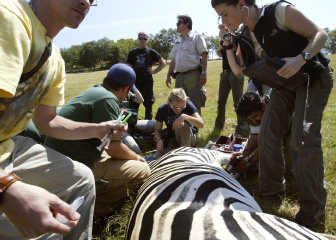
WINSTON, Ore. – In the front seat of the Ford Taurus, medical intern Andrea Chirife and Wildlife Safari ungulate supervisor Mary Iida were looking for Onyx, a zebra who’d been treated for sarcoid tumors.
The male zebra, slightly darker than the others, was running with a group of six others on a hillside at the Wildlife Safari drive-through animal park.
Chirife looked through binoculars, trying to identify him. The zebras crossed the road to a feeding station, which gave them a closer look.
When they were sure, Chirife aimed a gun at the zebra and shot it with a dart full of anesthesia.
“Good. 11:14,” said Claribel Leon from the back seat, noting the time on her clipboard.
Chirife turned to Leon, who works as a veterinarian in Spain at an animal recovery center and explained what would happen next. She hoped that the zebra would not go down near the rhinoceroses. The drugs would temporarily blind the animal, and it could head for a pond. They would have to work fast.
The zebra began to stumble, and Leon noted the time of the first effects of the drugs. They got out of the car and pulled a rope from the trunk, along with medical supplies. Head Wildlife Safari veterinarian Modesto McClean pulled up in a pickup full of veterinarians and students.
Two men lassoed the zebra, and Iida put a towel over its face.
“Jump out. Go help, quick,” McClean said, and the doctors and students ran up the hill to watch medical intern Tessa Lohe check to see if the cancer had returned.
Leon checked the animal with a stethoscope and hollered out the respirations. She was worried about the animal’s breathing.
“I’d get that oxygen on him,” McClean said.
A doctor worked on a catheter, while other students injected the zebra with vaccines. Chirife advised that if the rhinos got too close, people should run toward the vehicles, not up the hill where two wildebeests watched the procedure.
McClean was pleased with the results. The cancer treatment had been mixed with medical grade sesame oil to slow its release, and it had worked. The tumors hadn’t returned.
By 11:40 a.m., Onyx was up and walking. Leon continued making notes on the chart.
In the last four years, more than 300 students and doctors from around the world have come to the park to learn more about veterinary medicine through the Zoo, Exotics and Wildlife Club Workshop. It’s one of the few programs of its kind.
McClean began the program after he lectured at a university five years ago.
“Students were going to Africa to get these wildlife courses,” he said. And they were doing so at a cost of $4,500 to $5,000.
It was a lot of money just to learn the ropes of wildlife medicine, and many students couldn’t afford it, he said. So McClean told a professor she could bring her students to Wildlife Safari. She came with 17 students the first year.
Helen Newton, a student at Western College of Veterinary Medicine in Canada, said her school offers a four-week Africa trip, but it’s very expensive and is a long session for those who aren’t going into wildlife medicine.
She plans to have a mixed animal practice, but she might consider working with wildlife in the future.
“This is kind of my Africa trip,” she said.
This year McClean charged students $100. It’s the first time he’s charged at all. His wife, Kim, prepares some of the meals and puts together thick notebooks with handouts. McClean’s brother, Cliff Kohli, donated $2,000 to help with expenses, and Winston resident Steve Fisher offered the use of a three-bedroom house where some of the students stay during the program. Others sleep in offices at the park.
They get a lot for their money. They help vaccinate cheetahs, castrate juvenile bears and deworm elk, among other procedures. They also visit the Newport Aquarium, the Hatfield Marine Science Center, Oregon Health & Science University Primate Research Center, Brad’s World Reptiles and the Oregon Zoo. Afternoons are often filled with lectures by Wildlife Safari doctors and specialists from other parts of the state.
Rui Patricio has been a veterinarian for eight years in Portugal. He works mostly on dogs and cats, as well as some zoo animals. Working with herbivores in the park was new for him.
He said the cost was nothing compared with other programs, and more material gets covered. He likes seeing how other doctors perform procedures.
“You are always learning,” he said. “It’s one of the best places I have been.”
He thinks the workshop is valuable for students but even more so for doctors because they can participate more, and they have more knowledge to work from.
“I think it’s our responsibility to make medicine better,” McClean said.
He likes sharing his knowledge and hopes people will learn from his mistakes, too.
“They didn’t do this in veterinary school,” he said.
And he said schools in other countries have even less wildlife and exotic animal training, but the need for conservation is great.
“A lot of countries, they don’t want the gringo coming down there,” he said.
It’s better to have local doctors train others.
The workshop fits well with the vision of Frank Hart, Wildlife Safari’s founder, to educate people about animals, McClean said. And he knows it’s a cliché, but he believes it’s his destiny to work at the park and be part of that education.
He’s also worried about the future of veterinary education. Many teachers are leaving the field because they can make more money in private practice. The same is true for veterinarians who work in zoos. That could mean fewer advances in medicine, he said.
McClean is impressed with the doctors and students who came to the workshop.
“They’re spending their time to better themselves,” he said.
McClean is happy to help.