
Old-fashioned learning
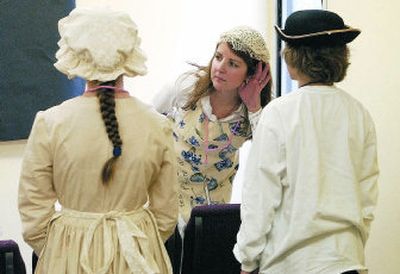
The girls wore aprons and mop caps. The boys wore tricorn hats, white shirts and tucked their pants into their socks.
Forty fifth-graders from Progress Elementary School marched across the street to immerse themselves in Colonial times at Veradale United Church of Christ.
“This immersion, hands-on experience will help them learn better than they would from books,” said the Rev. Linda Crowe. She and more than a dozen other adults wore colonial garb and did their best to play the roles of authentic colonial Americans.
Fifth-grade teacher Sharon Naccarato played the role of “Head Mistress” and tax collector. Ding, ding, ding, “Hear ye, hear ye, I’ve come to collect the taxes,” she said.
Each “colonist” was given shillings in the form of bright green copies of a miniature dollar bearing the face of King George, played by Progress Principal Matt Chisholm, who wandered the halls wearing a crown.
“They’re not just learning it,” he said, “They’re living it.” The young colonists were also able to earn shillings with good behavior.
The fifth-graders experienced old-fashioned activities including candle dipping, calligraphy, basket making and cooking, where they learned how to make applesauce, corn bread and butter.
The students also spent time in a Colonial school complete with a dunce cap. They sat in rows and stood at attention to recite their multiplication tables. They each had their own hornbook, which might be compared to today’s notebook. It was a wooden board with a handle; one side was a chalkboard and the other had the alphabet, letter blends, numbers and a Scripture or saying such as “look before you leap.”
In the classroom, the children learned George Washington’s “Rules of Civility and Decent Behavior.” The actual list contains more than 100 rules concerned with details of etiquette but time only allowed the learning of a few, including “Sleep not when others speak; Sit not when others stand; Speak not when you should hold your peace; Walk not when others stop.”
When asked if they might learn better in an environment such as this, the students had mixed responses.”Yes, because they’d discipline us more,” said Brianna Waco, 11. “We’d listen and learn more.”
Victoria Limbocker, 11, disagreed. “No, because the strictness and the discipline would put a lot of pressure on us and we’d be stressed out and tired.”
Besides the schooling and old-fashioned crafts, the children also learned what it meant to be a part of a large extended family, as many colonists were. The 40 students were put in groups of 10 that were given the same family name.
“Big families are a bad thing,” said Rebecca Richardson, 10, “Because you have to remember all the names.”
Alex Moseanko, 11, also thought it might be difficult because the houses back then were so small.
Zac Krieger, 11, thought that it was good because then you’d get more stuff done, and Waco said that a big family would mean more people to look out for you.
Crowe was pleased that the children got to immerse themselves in this educational experience. Church member Jean Nelson, 86, decked out in dress, apron and bonnet, said she can hardly wait to do it again next year.