
Drug traffic shifting routes
MANAGUA, Nicaragua – Central America has become a crucial way station in the billion-dollar cocaine business, with traffickers shipping hundreds of tons northward from Colombia along the isthmus and increasingly infiltrating police and government agencies, U.S. and regional sources say.
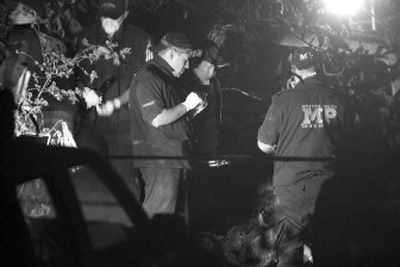
The recent killings of three Salvadoran legislators in Guatemala underscored the shift, intelligence sources say. The lawmakers were shot and their bodies set ablaze last month, allegedly by a group of Guatemalan policemen working on behalf of Mexican drug traffickers.
Everyone from impoverished fishermen and small-town mayors to legislators and high-ranking police officials has been swept up in the drug trade as the smuggling routes have changed. In years past, the favored route was across the Caribbean to the Southeastern United States. Now, with greater Mexican cartel involvement, the cocaine often moves up the coasts of Central America and overland through Mexico.
Although it remains unclear whether the dead Salvadorans were tied to traffickers, other lawmakers from the country have been linked to the trade. And Guatemalan officials have said the killings point to widespread infiltration of the country’s police force by organized crime.
The four police officers charged in the killings, including the head of the country’s organized-crime unit, later were slain in their prison cells in a stunning raid by armed men who might have entered the facility with the aid of guards and prison officials.
An intelligence official working in the region said the slain police officers worked for a Mexican cartel that ships drugs along the Pacific coast of Central America. The officers were enforcers dedicated to “knocking down” rival traffickers, the source said.
“This is a crime that can best be understood as part of the dynamic that sees drugs flow between Mexico and Colombia,” said a second intelligence official, referring to the killing of the legislators. The officials asked not to be named, given the sensitive political nature of the crime – one of the victims was Eduardo Jose D’Aubuisson, the son of the founder of El Salvador’s ruling party.
Although drug trafficking has long been common in remote areas of the region, such as the Caribbean coast of Nicaragua, the growing power of the Mexican cartels has increased the importance of Central America as a transshipment point.
Smuggling routes across the Caribbean have fallen out of fashion thanks to U.S. interdiction efforts there, and Colombian drug producers have ceded the bulk of the transportation business to Mexicans.
About 90 percent of the estimated 780 tons of cocaine entering the United States annually passes through the hands of Mexican drug traffickers, according to U.S. studies. Mexican traffickers see Central America as a natural hub between their Colombian suppliers and the smuggling routes the Mexicans control on the U.S. border.
The “Mexico-Central America corridor is … the predominant transit route for cocaine destined for the United States,” U.S. officials wrote in the 2007 National Drug Threat Assessment.
The growing trade has reached areas of Central America where drug trafficking was rare just a few years back. Police and military forces there are often undermanned and outgunned.
Nicaragua’s small navy, for example, has only enough boats to patrol its coastline 12 days each month, officials say, a fact that helps shape the traffickers’ strategy.
On the Pacific coast, the Nicaraguan navy has no craft larger than 40-foot-long “go fast” boats with outboard motors, vessels nearly identical to those the drug traffickers use. In fact, many of the craft used by the navy are boats that were discarded by smugglers, Gonzalez Diaz said.
Operatives of Mexico’s Sinaloa cartel arrived on the Pacific coast two years ago, according to officials with Nicaragua’s National Police.
With their Mexican accents, the men stood out. They were eager to buy old, abandoned farms along the beach. They didn’t look like farmers, but they bought several tractors. They collected boats, too, but they didn’t look like fishermen.
“The tractors were to build new airstrips and also to rehabilitate old ones,” said one Nicaraguan police officer who specializes in drug intelligence.
Nearly all of the cocaine that enters the United States is produced in Colombia, according to studies by U.S. officials. Most of the cocaine enters the U.S. through a two-stage process in which it is off-loaded and stored at least once in Mexico or Central America.
Cocaine is shipped out of Colombia by sea and air, usually in amounts of a ton or more, through what U.S. officials call “the transit zone” – the stretch of ocean between Colombia and Mexico. Sometimes the traffickers hopscotch up the coast from Colombia to Panama, Costa Rica and other countries in the “go fast” boats. Or they might take a more circuitous route that involves a larger ship that will travel around the Galapagos Islands in the Pacific southwest of the Colombian coast and later off-load to smaller vessels.
Once in Mexico, the drug traffickers benefit from well-traveled smuggling routes protected by corrupt state and local officials as their shipments move northward overland to the U.S. border. A war among competing cartels to control those routes, known as “plazas” in Mexico, led to more than 2,000 killings last year.
The various routes through the “transit zone” pass through the beaches of Belize, seaside villages in Honduras and ports along the Pacific coast of Mexico and many other places, according to data from the U.S. Government’s Joint Interagency Task Force South, based in Florida.
U.S. officials said that Central American organized-crime groups, working with the Mexican and Colombian cartels under a subcontracting system, are reaping huge profits. That money, in turn, is fueling a crime wave, especially in Guatemala and El Salvador.