
Bush names military care panel
WASHINGTON – President Bush on Tuesday named former Sen. Bob Dole and former secretary of Health and Human Services Donna Shalala to co-chair a bipartisan commission examining the care America’s wounded troops receive after they return from the battlefield, one more among several high-level reviews and investigations spawned by recent revelations of squalor and bureaucratic woes facing veterans at Walter Reed Army Medical Center.
The commission will look at the treatment U.S. troops receive from the time they leave foreign battlefields through their return to civilian life. Bush also announced that he has asked the secretary of Veterans Affairs to lead a Cabinet-level interagency task force to deal with immediate shortcomings in helping veterans of Iraq and Afghanistan.
“We have a moral obligation to provide the best possible care and treatment to the men and women who have served our country,” Bush said to an audience of war veterans with the American Legion in Washington. “They deserve it, and they’re going to get it.”
Bush again said the conditions at Walter Reed described in a series of Washington Post articles are troubling and that the situation is unacceptable: “My decisions have put our kids in harm’s way, and I’m concerned about the fact that when they come back they don’t get the full treatment they deserve.”
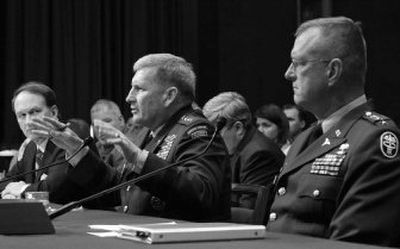
As Bush was speaking Tuesday morning, members of the Senate Armed Services Committee were expressing dismay on Capitol Hill as they opened hearings on Walter Reed, with both political parties criticizing Army and Defense Department leaders who apparently were unaware of systemic problems in outpatient care despite multiple warnings.
Echoing what members of a House committee said on Monday at a hearing at Walter Reed, senators said that they believe problems such as mold and rodents at the medical center’s Building 18 indicate larger issues with leadership and a stifling bureaucracy.
“Good leadership should have taken these steps long ago, without prompting by a series of embarassing news articles,” said Sen. Carl Levin, D-Mich., the commitee’s chairman, railing against what he sees as an overly complex system that shortchanges U.S. troops. “The American people are deeply angry about the shorfalls in care. The war in Iraq has divided our nation, but the cause of supporting our troops unites us.”
Walter Reed’s commander, Maj. Gen. George Weightman, and Army Secretary Francis Harvey both lost their jobs last week following the revelations.
Bush’s new commission and Veterans Affairs task force come as the House and Senate have launched hearings about the problems at Walter Reed and as Defense Secretary Robert Gates awaits the results of an independent review group that has 45 days to assess outpatient treatment.
In the wake of early comments from senior officials minimizing the reports of dilapidated facilities and devastating delays at Walter Reed, Army officers have dispatched soldiers to evaluate nearly a dozen hospital facilities nationwide in an attempt to locate any similar problems.