
Helping hands: Center serves deaf and hard of hearing
Most folks start their day with the shrill bleating of an alarm clock.
Char Parsley’s day begins with the bright on/off flashing light of a special bedside clock.
Parsley is the director of the Eastern Washington Center for the Deaf and Hard of Hearing.
Deaf since birth, she is in a unique position to understand the daily challenges of those who are a silent part of a noisy world.
EWCDHH, near the Spokane Arena, is a nonprofit service center and outreach organization dedicated to assisting the deaf and hard of hearing in 10 counties throughout Eastern Washington.
Parsley and her staff, assisted by an interpreter, were happy to explain the goals and services offered by this organization.
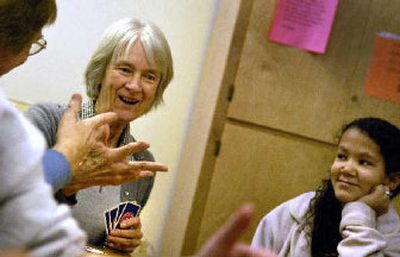
A good-natured game similar to musical chairs ensued around the table, as everyone made sure they could see the interpreter, Lynn Lumsden, as well as each other. There is an etiquette to communicating with the deaf that the hearing community is largely unaware of.
Parsley signed and Lynn Lumsden interpreted, “Many people address the interpreter, not the deaf person,” she said.
“That is rude. One should make eye contact with the person to whom they are speaking.”
The goal of the center is to provide support and assistance to the deaf and hard of hearing and to connect them to various services offered in the area.
Case manager Elaine Navratil, who is also deaf, said, “I do a lot of advocacy work to make sure services are offered to the deaf community.”
For instance, EWCDHH sponsors a hearing aid program.
“Private insurance doesn’t cover the cost of hearing aids,” Navratil said. “The average cost is anywhere from $1,000 to $4,000 per hearing aid.”
Ironically, most insurers will cover the cost of cochlear implant surgery, but many in the deaf community may not be good candidates for the surgery, and many choose not to have it.
With some financial assistance from the city of Spokane, the center offers refurbished hearing aids. Local Lions clubs collect them, and Western Hearing Aid center refurbishes them.
Another service EWCDHH provides is an interpreter program.
Nancy Hockley is the interpretive services coordinator.
“My job is to match the interpreter to the situation,” she said.
According to Hockley, many people with hearing loss don’t understand that businesses, the medical community and schools are required by law to provide interpreters for their deaf clientele.
“For instance, deaf parents might need an interpreter to communicate with their child’s school, or a senior might need an interpreter to go with them to a doctor’s appointment,” she said.
The center also provides practical assistance such as vibrating or flashing alarm clocks, flashing lights for doorbells, and phone amplifiers. Parsley said they recently gave out 110 strobe-light fire alarms.
EWCDHH also hosts a social club each Thursday, where the deaf community can relax and have fun. They drink coffee and play board games and often have special speakers.
It’s also a popular place for students enrolled in Spokane Falls Community College sign language program to hang out and practice their skills.
Video phone technology is now offered at the center.
“You can call any number, and the call goes to a video relay system,” said Navratil. A real-time translator is standing by and interprets the call for the user.
“I used to have to go to a neighbor’s house to make a call or wait till my kids came home,” she said.
Technological advances are helpful but can’t ease all the struggles the deaf and hard of hearing deal with as they function in a hearing world.
“One of my biggest challenges is when people ask if I can lip read,” Parsley said. “The very best lip readers can only interpret 30 percent of a conversation.”
Navratil agreed and said, “The question can be an affront.”
Parsley said her solution is to write notes back and forth when conversing with hearing people.
“I mostly communicate with pen and paper.”
According to Parsley, in any given population 10 to 20 percent have some hearing loss or difficulty. The struggle to educate the community about the deaf and hard of hearing is twofold.
The community must understand the rights of the deaf to equal access and opportunity, and the deaf must learn about the opportunities available to them.
“Education for the deaf in Washington state is lacking,” said Parsley. “The deaf community needs to be educated about their rights.”