
Leftists to welcome, protest Bush visit

WASHINGTON – When President Bush heads to Latin America today, he’ll find that despite the region’s much discussed “leftward tilt,” many of its populist leaders are setting ideology aside and seeking warmer ties with the United States.
Conservatives govern three of the five countries on Bush’s itinerary: Guatemala, Mexico and Colombia. But he’s likely to receive his warmest welcome at his first stop, in Brazil, whose president, Luiz Inacio Lula da Silva, is a socialist former union leader who once was critical of free trade.
“There is now a demand, an expectation, from the Brazilian business community and the Brazilian policy community for more engagement with the United States,” said Paulo Sotero, the Brazil director for the Woodrow Wilson International Center for Scholars, a Washington research center.
Sotero said that many in Brazil thought that Lula had missed an opportunity to engage more in trade talks with the United States. “The environment in Brazil is far from hostile for President Bush,” he said.
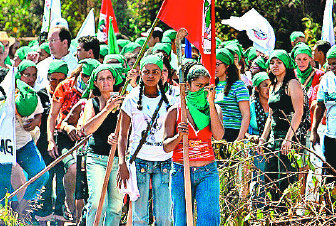
Several left-wing groups are planning street protests, however. Brazil is often critical of U.S. trade policies, and it resents a 54-cent-a-gallon tax on its ethanol exports to the United States.
Bush and Lula will see whether they can revive the stalled Doha round of world-trade talks and put the finishing touches on an agreement to promote greater use of biofuels, one of the few new initiatives that will be highlighted in Bush’s weeklong visit.
Bush moves on to Uruguay to meet another leftist president, Tabare Vasquez, on Friday, a day that coincides with an anti-Bush rally in neighboring Argentina, where Venezuela’s leftist president, Hugo Chavez, is to be the lead speaker. But Vasquez is putting out the welcome mat for Bush, and the two will go fishing together at a national park.
The United States is now a top destination for Uruguayan exports along with Brazil, and Montevideo and Washington signed a trade and investment pact in January that was widely seen as a precursor to free-trade talks.
Anti-Bush protests also are planned in Montevideo, but Uruguay considers the United States a useful counterweight in its environmental dispute with Argentina over a multibillion-dollar pulp mill. It perceives the Mercosur trade pact – with Brazil, Argentina, Venezuela and Paraguay – as unfair to the group’s small partners.
Bush is to arrive in Colombia on Sunday at a difficult moment for President Alvaro Uribe. Though personally popular, Uribe is facing an uproar over alleged links between paramilitary death squads and government officials.
The U.S. Congress has held up a free-trade deal, and human rights concerns have delayed some U.S. military-aid disbursements and raised questions in Congress over the $700 million a year the United States gives Colombia to help combat drug trafficking.
“The reception in Colombia will be warm but with a tinge of disquiet,” said Michael Shifter, of the Inter-American Dialogue, a Washington policy organization. He said Bush should “encourage Uribe to clean up” or continue to face a difficult time in Washington.
On Monday, Bush is to be in Guatemala, reaching out to the large indigenous community there by visiting a farm cooperative and the Iximche archaeological site. Bush is eager to show how a Central American nation is benefiting from the controversial 2005 free-trade pact with Washington known as CAFTA.
Guatemala also is struggling to cope with drug gang violence. And pro-U.S. President Oscar Berger is likely to push Bush for a better treatment of Guatemalan migrants in the United States.
Bush is scheduled to wrap up his visit in Mexico, where President Felipe Calderon has drawn U.S. praise for using troops to crack down on drug violence and extraditing some traffickers. Calderon wants an immigration agreement with the United States – which his predecessor, Vicente Fox, failed to secure – but he’s downplayed expectations and is focusing on economic reforms that would keep migrants at home.
Calderon also will have his domestic constituency in mind as he discusses thorny agricultural issues with Bush, such as trade in corn and beans.
Bush, who’s to return to Washington next Wednesday, said he admired Calderon’s courage and would listen to his needs. “Part of my visit is to be a listener and a partner,” he said.
Beyond the immediate impact of Bush’s trip, some experts say U.S. relations with Latin America will not significantly improve until Washington develops policies that go beyond promoting free trade and open markets. Nor, they say, will Bush be effective in countering Chavez.
“Chavez is a symptom of Latin America’s deep concern with poverty and inequality and the U.S. will not be successful until it develops policies that address these problems directly,” said William LeoGrande, a Latin American expert and dean of American University’s School of Public Affairs.