
Sprague Ave. makeover

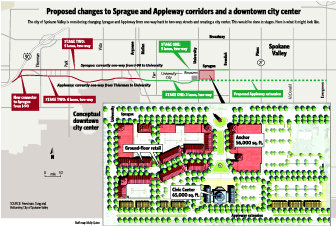
It was a scene ripped from the script of “Extreme Makeover” last week as experts laid out their plans to revitalize Sprague Avenue to Spokane Valley city officials.
Designers called for trees on Sprague Avenue, a downtown on the city’s main drag where it intersects with University Road, and traffic and design changes literally for six miles from Interstate 90 to Sullivan Road.
The big news that day, March 1, was the recommendation that the one-way traffic on the two-mile Sprague Avenue/Appleway Boulevard couplet be replaced with two-way traffic. Adding to that news, consultants recommended that Appleway Boulevard, which now ends at University Road, be punched through to Evergreen Road.
The changes, said consultant Michael Freedman, of the San Francisco-based design firm Freedman, Tung and Bottomley, were to improve the economic health of Sprague Avenue, to respond to what experts are calling “advanced disinvestment” along the strip, meaning the commercial flight away from it to areas along the Interstate and even Sullivan Road.
“Disinvestment along Sprague is fairly advanced,” said Freedman as he clicked through a PowerPoint presentation of large empty buildings along the street. The images were bleak, but Freedman cautioned. “The potential for change is substantial.”
Mayor Diana Wilhite told Freedman she liked what she saw of the changes he and others from six different expert groups were recommending. Her council peers echoed the sentiment and indicated a willingness to consider at least the reversal of the couplet and extension of Appleway Boulevard. They’ll have to decide if the changes are worth presenting at public hearings and eventually worth a vote of action.
The Spokane Valley City Council last year decided to spend more than $400,000 for an urban design and transportation plan. Thumbnail descriptions of that plan are listed below:
The couplet and town center
The strongest argument for undoing the couplet was its underuse. When the couplet was built, it was expected that Appleway, four lanes wide between Thierman and University roads, would take on a crush of eastbound traffic, transporting cars onto University and then pouring them back onto Sprague. The eventual goal was to punch Appleway three miles farther east to Sullivan, creating a no-nonsense speedy route through the suburbs with no roadside retail to distract people from getting from point A to point B.
Five years after the creation of the couplet, the state expanded Interstate 90 from four lanes to six, and some of the commuter traffic that analysts expected to take Appleway home opted to stay on the newly widened freeway.
Traffic consultant Troy Russ told the Spokane Valley City Council that only a small portion of the traffic on Appleway during rush hour actually traveled the road from start to finish. During the evening rush hour, the busiest time of day for Appleway, more than half the cars turned off at Dishman-Mica Road. Only 21 percent of the traffic made it back onto Sprague Avenue to continue traveling through town. Consultants are now proposing one of Appleway’s four lanes be dedicated for traffic destined for southbound Dishman-Mica, that one lane become a center turn lane and the remaining two be dedicated to two-way traffic. East of Dishman-Mica, the road would be narrowed and made more livable.
Of the 1,940 cars that exit onto Appleway from the freeway during evening rush hour, only 80 continue to Sullivan Avenue via Sprague.
On Sprague, designers have proposed narrowing its six driving lanes and center turn lane to five, as well as adding curbside parking and landscaping to make the street not only more attractive but livable. Urban designers like Freedman crafted design land use proposals intended to get people traveling Sprague again. As Freedman put it, you can’t just build a road and not give the people driving it somewhere to go.
That land-use plan would pave the way for a city center, mixed-use development and regulations to foster more sustainable business growth along Sprague and Appleway.
Urban designers are recommending the Council essentially plan for a downtown at the intersection of University Road and Sprague, as well as several neighborhood retail shopping areas at the busiest intersections along Sprague. Slowly, the spaces in between those intersections would shy away from shopping-cart retail, filling in with offices, service-based businesses and even housing.
The town center, anchored by a municipal building, retail shops and office space, would be complemented by neighborhood retail centers, housing on Appleway Boulevard and an improved Auto Row.
Neighborhood center retail
According to Freedman, neighborhood centers are areas of concentrated business activity that provide retail shopping and services targeted for the greater neighborhood of about 5,000 to 8,000 homes surrounding the center. Neighborhood centers are typically anchored by a large store like a supermarket. If for no other reason, neighbors come to the center to shop at its large anchor store.
The space surrounding the anchor store is reserved for smaller retail business of 10,000 to 25,000 square feet in size. Groceries might be the reason people come to the center, but shops like small-scale restaurants, fitness clubs, and personal and business services located around the anchor are supposed to keep people around.
The idea is to concentrate a lot of activity in a relatively compact area, consultants say. To keep business from sprawling away from the center, city policies would have to be crafted specifying that neighborhood centers were the only locations allowed for some types of new businesses. An existing bookstore, for example, wouldn’t have to move to a neighborhood center, but a new bookstore might not be allowed to locate outside a center.
Freedman said store fronts for smaller shops should be contiguous to give them a downtown feel. He also recommended placing parking in the back of the businesses and putting storefronts side by side and right along the street sidewalk to give the center more of an urban, and walkable, feel.
The ingredients for these hubs exist already. The intersection of Sullivan Road and Sprague Avenue already buzzes with people shopping for groceries at Fred Meyer, getting prescriptions filled at Walgreen’s, renting DVDs at Hastings and Hollywood Video.
Another example would be the intersection of Sprague and Evergreen, Safeway, Target and Staples draw customers.
Freedman’s recommendation was that the city designates roughly a half-dozen centers to the exclusion of others.
Between the neighborhood centers
In the areas of Sprague not included in neighborhood centers, consultants recommended encouraging a mix of uses. Office space might be a reasonable use for those in-between areas, Freedman said. Other businesses that might do well outside neighborhood centers are so-called “medium box” stores, like R W Gallion Floors at 12701 E. Sprague Ave. A flooring business doesn’t fit into the small-shops concept of neighborhood centers.
And Sprague Avenue has a considerable number of medium-box stores, Freedman said.
Ideally, multifamily housing would start showing up on Sprague once steps were taken to make the street more livable. Plans include narrowing the street to four lanes in each direction, plus a turning lane. The eliminated lanes would be converted to tree-lined landscaped strips separating pedestrians from traffic.
The biggest hurdle might be convincing Sprague landowners with property outside neighborhood center areas to consider investing in residential development on a historically commercial strip. What’s proposed wouldn’t force any landowner to abandon his commercial venture for residential, but it might mean dictating that any future project be limited to medium box, office or residential.
But landowners need to consider the economics of the Sprague corridor, Freedman said. Retail space along Sprague at locations away from traffic-signaled intersections is renting for $2 to $4 a square foot, which is comparable to residential rents, Freedman said. And if Sprague is made more livable, profits from residential leases could be more profitable than some commercial property is currently.
On Appleway
Consultants recommended not creating more retail space along Appleway Boulevard as the street expands eastward, in part because too much retail space over too long a distance is considered a cause of Sprague’s economic doldrums. Instead, designers recommended multifamily housing, duplexes and larger be allowed along the boulevard. Office space would be allowed as a transition from Appleway residential to the businesses between Appleway and Sprague.
Style-wise, what designers recommended was a mix of duplexes and multiunit apartments that look more like large homes than apartment units stacked like plates. They’re recommending deeper front yards to buffer the buildings from Appleway, but also that the units face the street, so they look like they’re part of it.
Again, what’s proposed for Appleway traffic is similar to Sprague, with parking and landscaping to turn the street into a residential street, or “grand boulevard.”
The plan does allow for corner stores and retail food services no larger than 3,500 square feet. The stores would have to be integrated into larger residential or office buildings.
Big changes for auto row
Finally, some of the biggest design changes proposed are for the multiple blocks of car lots known as Auto Row, along the Sprague/Appleway couplet. Car dealers, who met face to face with the city’s design crew, described the current couplet as dysfunctional. Designers proposed narrowing the street by restoring two-way traffic, adding a center turn lane and creating curbside parking on both sides of the street. At the dealers’ request, they also recommended burying utilities and getting rid of telephone poles along the avenue.
Also, designers proposed creating a monument at the beginning of auto row to give motorists a sense of arrival as they drive into it.
Further recommendations included bringing future dealership buildings up to the sidewalk to make the area look like less of an “asphalt sea.”