
GONE TO THE DOGS
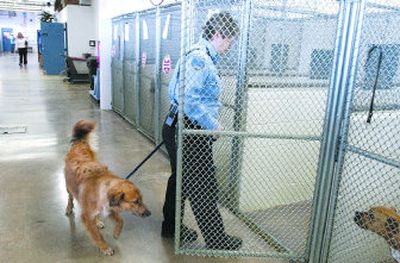
At times stray dogs in Sandy Lampe-Martin’s neighborhood have been such a problem that the Edgecliff resident and her husband have baited a cage in the back of their pickup to collect them.
There were the two brindle pit bulls the couple found roaming their neighborhood a month ago. Good dogs, Lampe-Martin said, but very much out of place considering their home was more than a mile away and separated by Interstate 90 and the seven lanes of East Sprague Avenue. Earlier this week, it was a trio of strays, a cocker spaniel, collie mix and some odd breed of big dog, weighing well over 100 pounds with a head shaped like a square-pointed shovel. The three knocked over garbage cans and generally scared small children and the elderly.
“I think the biggest problem was have is dumped dogs,” she said. “Loose dogs get picked up fairly quickly by their owners, but these dogs have no collars. They get dumped at the end of Park (Road) and they’re hungry and they come down here.”
Spokane Valley, not just Edgecliff, is going to the dogs. The Spokane County Regional Animal Protection Services, which patrols the city, reports that of the more than 4,000 Spokane Valley calls it responded to in 2006, half involved strays. One hundred and twenty nine of those dogs had threatened people. Another 30 dogs threatened other animals.
It’s a problem that can raise insurance premiums, endanger both the public and the dogs running loose. The end result in some cases is a good animal being killed for no other reason than its owner would not care for it.
“Last year was a record year” for strays, said Nancy Hill, SCRAPS director. “Every year is a record year.”
Law enforcement in the greater Spokane area last year reported at least seven dogs being killed almost immediately after violent attacks on people or other animals. The cases range from a stray boxer shot to death by a police officer near Rathdrum, Idaho, after withstanding several Taser jolts and continuing to attack, to two pit bulls who ripped off a 12-year-old Spokane boy’s ear and upper lip before being subdued with bats and sticks.
The attack on the 12-year-old was the only case in which the dogs were at home.
The most recent attacks involved a boxer and pit bull that strayed three blocks from home and brought down a horse on Conklin Road in Spokane Valley by biting and hanging from its face and neck before the horse fell. The horse had to be killed and so were the dogs, after their owners declined SCRAPS demands that a no-escape kennel be built for the animals and special liability insurance be purchased.
However some insurance companies are refusing home insurance policies to owners of particular dog breeds, or offering steeper rates.
“I’m not a big insurance expert, but I’ve heard from a lot of people that if you have an event on your homeowner’s policy, you’re probably going to be shopping for a new one,” Hill said.
Any owner of a dog deemed dangerous in Spokane County, and most dogs deemed dangerous have been found at large, are required to carry at least $250,000 in liability coverage or forfeit their animal.
Nationally, owners of dogs considered bite risks are being denied coverage or charged higher rates. Pit bulls, Rottweilers, Doberman pinschers and German shepherds are breeds some companies consider too much of a gamble to insure at normal rates, if at all. Last year, dog bites cost the insurance industry $317.2 million, according to national underwriters.
In Washington, there’s legislation, House Bill 1105, currently making its way through the Legislature to prevent insurers from limiting or canceling a homeowner’s policy based on the type of dog the homeowner has.
There’s nothing on the law books now preventing an insurer from taking the breed of a customer’s dog into consideration when writing a policy or refusing coverage, said Stephanie Marquis of the Washington Insurance Commissioner’s office. This isn’t the first time lawmakers have proposed making a dog breed off-limits when underwriting insurance policies, Marquis said. At least one other bill died in the Legislature.
The bill’s proponents say allowing dog breed to factor into a homeowner’s coverage is no different than racial profiling. Punish the deed, not the breed is a common battle cry.
But insurers and some lawmakers disagree. When the bill first surfaced, it made a blanket statement that all dog types be excluded from profiling, but an amendment was quickly proposed effectively making the nondiscrimination rules apply only to dogs that at adult age weigh 10 pounds or less. Other changes suggested would require pet owners to submit letters of character from dog trainers, veterinarians or the American Kennel Club.
At the least, homeowners would still face higher insurance rates, policy cancellations or refused coverage if their dogs are deemed dangerous, which can be an easy label for a loose dog to pick up if fearful neighbors start calling SCRAPS.
A dog that physically threatens a neighbor or another animal can be declared dangerous without actually biting anyone. And the likelihood of a dog biting someone jumps considerably when a dog is loose, feeling threatened or afraid, confronted by strangers, or engaged in a chase.
“It isn’t just about public safety. It’s about animal welfare,” Hill said. “Dogs get hit by cars. Dogs get poisoned.”
It’s all avoidable if a dog owner keeps his pet on private property and otherwise leashed whenever it’s away from home. Rarely is a dog declared dangerous if it’s in its own yard, Hill said.