
Program builds work force, helps addicts start over
Manufacturers eager to hire workers in a tight job market may eventually look to a new recruiting ground: the Kootenai County Jail.
The concept is the brainchild of Ron Nilson, president of Ground Force Manufacturing in Post Falls. Like many of his peers, Nilson struggles to find qualified workers. His company, which builds water and fueling trucks for the mining industry, has a 12-month backlog of orders. If he could find the right people, Nilson said he would hire 25 employees on the spot.
Last year, when Nilson served on a citizens advisory committee for a jail expansion, he noticed that the inmate population fit a target hiring group – men ages 18 to 35. But many of the inmates had drug or alcohol addictions. Most lacked job skills and a sense of purpose, Nilson said.
“It became a matter of how do you make two problems a solution,” he said.
Nilson teamed up with Pastor Tim Remington of Good Samaritan Rehabilitation Inc. in Coeur d’Alene to craft a proposal. They came up with North Idaho Training and Rehab Organization, or NITRO.
The program – still in a formative stage – would expose recovering addicts with criminal pasts to careers in skilled trades, such as carpentry, fabrication and welding. The yearlong program would incorporate drug and alcohol treatment, life skills training and job placement.
NITRO pairs the two men’s passions. Nilson is an outspoken advocate for vocational education. He often speaks at local high school career days, telling kids they don’t need a four-year degree to make a good living. Skilled workers start at wages of $12.50 per hour in his shop. With experience, workers can earn $40,000 or more per year, according to Nilson, who also heads the North Idaho Manufacturers Consortium.
Remington, meanwhile, is known for his work with meth addicts. In addition to running Good Samaritan Rehabilitation, he’s spent 17 years counseling inmates at the county jail.
NITRO is their common ground. The men said they’re still laying the foundation for the program, which doesn’t yet have a starting date. When it does begin, NITRO will start out small – with 10 or 12 recovering addicts, Remington said.
The individuals would complete Good Samaritan’s 120-day faith-based treatment program. After the treatment ends, companies recruited by Nilson would hire the individuals, providing job training and mentoring.
“It won’t fill my shop,” Nilson said, noting that his immediate openings are for experienced welders. But the job experience will help recovering addicts make positive changes in their lives, he said. And at least some, he predicted, will go on to master a skilled trade.
“What better time than when our economy is at full strength to fill in these positions?” Nilson said. “… This is what it takes to serve these lost souls.”
Securing a job is critical to an addict’s long-term recovery, according to Remington.
“It gives them an identity,” he said. “They feel like they’re accomplishing something.”
The concept has been well-received by local judges and the Kootenai County public defender’s office.
First District Court Judge John Mitchell estimates that 70 percent to 80 percent of the offenders he sees in court during a typical week are there on drug-related charges or crimes related to an addiction.
“If you can find them good work, that’s a huge positive factor in keeping the addict clean,” he said.
Through work, addicts will meet new acquaintances, so they will be less likely to associate with old friends who might tempt them back into drug use, Mitchell said. In addition, most manufacturers have random drug testing, which provides a high level of accountability, he said.
“It could create long-term stability for a lot of people who are serious about successfully dealing with their addiction,” Mitchell said.
Since the treatment program is faith-based, it would be strictly an opt-in program for interested candidates. Some judges credit time spent in residential treatment programs against jail time, or make completion of such programs a condition of parole.
NITRO would be privately funded, according to Remington. At Good Samaritan, three months of residential treatment costs about $2,000 – money that comes from private donations.
The agency has a women’s residential recovery program in Coeur d’Alene. It offers outpatient treatment to men but plans to open a second residential rehab facility for men in the future.
Companies who hire the recovered addicts would pay the cost of job training and mentoring for the individual.
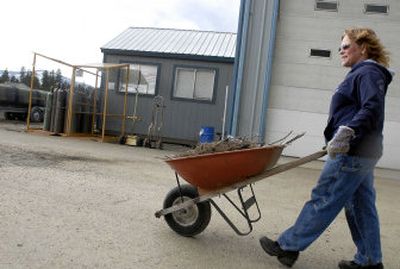
The NITRO concept is getting a test run at Ground Force Manufacturing with Tracy Lee Yanzick. Nilson hired Yanzick, a 44-year-old Post Falls woman, two months ago.
Yanzick has a criminal record in Montana, including a conviction for possession of dangerous drugs. She had regained her sobriety through a treatment program, she said, but lost it during a financial crisis. Yanzick turned to Remington, who helped her land a job interview at Ground Force Manufacturing, where she convinced Nilson that her desire to stay clean was sincere.
Last week, “Just a Closer Walk with Thee” and other old-time gospel hymns blared from the stereo in Yanzick’s Ford Focus as she trimmed weeds at Ground Force Manufacturing. She performs janitorial duties and runs errands for workers in the shop, fetching coffee and parts.
Yanzick is learning how to read blueprints. She can picture herself learning machinist skills and someday working at a trade.
“Having a job gives me focus,” Yanzick said, “and the love that they show is so awesome. They care about my direction in life. … It’s the Jesus in them that’s making a difference.”
General Manager John Chambers has encouraged her interest in blueprints. He and Nilson monitor Yanzick’s job journal, a frank account of her daily activities and how she’s getting along at work.
Regular drug tests are a condition of Yanzick’s employment. Ground Force has a zero tolerance policy for substance abuse.
Yanzick said the accountability is helping her overcome “worldly struggles” and the temptation to slip into old ways.
Nilson is interviewing inmates at the county jail, looking for other men and women who would fit the program. It saddens him to hear some of their stories. But there’s a certain toughness to the screening process.
To succeed, participants need the maturity to take responsibility for their actions, Nilson said. He also looks for signs of respect and an ability to conform to the rules.
“I’m not ‘dude,’ ” he said. “I’m Mr. Nilson if you’re in an interview. … We’ve got to tell them what real life is about.”
Custom-home builder Michael Cramer, who is a friend of Remington’s, has put about a dozen recovering addicts to work at short-term jobs at his Hayden company, or recommended them to other contractors.
NITRO has the added benefit of providing job mentoring, he said. Most business owners, if they’re willing to take the time, have valuable life lessons to share with others, Cramer said.
“If a guy’s 50 years old and runs a business,” he said, “you figure he’s been around the block.”