
Senator suggests link between firing, probe
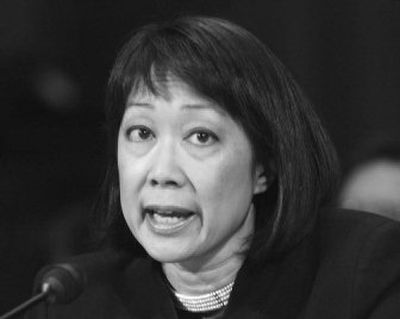
WASHINGTON – Fired San Diego U.S. attorney Carol Lam notified the Justice Department that she intended to execute search warrants on a high-ranking CIA official as part of a corruption probe the day before a Justice Department official sent an e-mail that said Lam should be fired, U.S. Sen. Dianne Feinstein said Sunday.
Feinstein, D-Calif., said the timing suggested Lam’s dismissal may have been connected to the corruption probe.
Justice Department spokesman Brian Roehrkasse denied in an e-mail that there was any link. “We have stated numerous times that no U.S. attorney was removed to retaliate against or inappropriately interfere with any public corruption investigation or prosecution,” he wrote.
But the revelation could heighten demands in Congress for a full investigation into whether something other than job performance was behind the Justice Department’s dismissals late last year of eight U.S. attorneys, including Lam.
On Sunday, Senate Judiciary Committee Chairman Patrick Leahy, D-Vt., said he intends to force President Bush’s top political adviser, Karl Rove, to testify and will insist that the testimony be under oath. Leahy, who appeared on ABC’s “This Week,” said he is “sick and tired” of the administration’s changing rationale for the firings.
Justice Department officials originally told Congress the U.S. attorneys had been dismissed for poor performance. Since then, it’s become known that most of the attorneys received positive job evaluations.
Last week, the Justice Department released e-mails showing that loyalty to President Bush and Attorney General Alberto Gonzales was among the criteria used to judge U.S. attorneys’ performance, and that Rove and former White House counsel Harriet Miers were deeply involved in discussions leading up to the dismissals.
Roehrkasse said the Justice Department would provide additional e-mails to Congress today. The documents were to have been surrendered last week, but Justice officials delayed the delivery, saying they needed more time to prepare them.
In an appearance on CBS’ “Face the Nation,” Feinstein said she’d not yet decided what motivated Lam’s dismissal.
“There were clearly U.S. attorneys that were thorns in the side for one reason or another of the Justice Department,” Feinstein said. “The attorney general has said he did not know what was going on … that is very difficult for me to believe.”
Feinstein said Lam notified the Justice Department on May 10, 2006, that she planned to serve search warrants on Kyle Dustin “Dusty” Foggo, who’d resigned two days earlier as the No. 3 official at the CIA.
On May 11, 2006, Kyle Sampson, then Gonzales’ chief of staff, sent an e-mail to deputy White House counsel William Kelley, asking Kelley to call to discuss “the real problem we have right now with Carol Lam that leads me to conclude that we should have someone ready to be nominated on 11/18, the day her 4-year term expires.”
The e-mail did not spell out the “real problem,” and it was unclear whether Kelley and Sampson talked later.
Until now, lawmakers have focused on two of Lam’s other inquiries into Republicans as possible ways in which she may have chafed the administration.
Lam oversaw the investigation that led to the corruption conviction of then-Rep. Randy “Duke” Cunningham, R-Calif., who pleaded guilty in late 2005 to accepting $2.4 million in bribes. He was sentenced in March 2006 to eight years and four months in prison.
On the same day last year as the Sampson e-mail, the Los Angeles Times reported that the Cunningham probe was being expanded to look at the actions of another California Republican, then-House Appropriations Committee Chairman Jerry Lewis.
Feinstein did not say how she learned that Lam had notified the Justice Department about her plans to serve search warrants on Foggo, who on May 8 had resigned as the executive director of the CIA. FBI agents seized records from Foggo’s CIA offices and his suburban Vienna, Va., home on May 12.