
Mane Reflections clients go to great lengths for Locks of Love
Hair loss at any age is a traumatic thing, to a youngster it’s devastating – and more common than you may realize. While most people are familiar with the term “male pattern baldness” there are other causes and conditions, including severe burns or medical treatments, that can result in hair loss in people of either sex and at any age. The most common condition may be alopecia areata, an auto-immune condition with no known cause or cure.
According to an article in Pediatric Dermatology, alopecia areata is characterized by the sudden appearance of sharply defined round or oval patches of hair loss. In some cases it leads to a complete loss of all body hair. Although the condition can occur at any time, the first attack usually appears in patients under age 25.
Whatever the reason, as a child loses hair, confidence and self-esteem are often lost as well. But thanks to Locks of Love, a national not-for-profit organization, the trauma is being eased for more and more youngsters each year.
First established in 1998, Locks of Love provides custom-fitted hair prosthetics to financially disadvantaged children 18 and younger. The hairpieces are hand assembled and made entirely from donated human hair. According to the Locks of Love Web site, more than 2,000 hair donations are received through the mail each week, 80 percent of them from children.
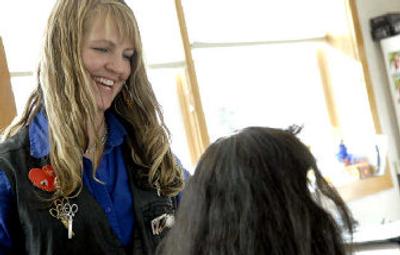
Penny McGuire, a cosmetologist at Mane Reflections in Sandpoint, has been involved with the program from the very beginning.
“Marcie Thompson (a salon client) inspired me,” McGuire said. “It was 1998, I was pregnant with my son, and she came in and donated all of her hair except for half-an-inch … When I asked her about it, she told me about Locks of Love and I thought it was the coolest thing. I found the organization online, got their guidelines, and then I cut my hair.”
Since then, McGuire has donated a second time, 22 inches in all, and is growing her hair out to donate a third time. She marvels when she recalls all the personal stories she’s heard over the years, stories that help explain a person’s decision to donate.
“Everybody has a story. Either they’ve lost somebody, or they’ve been through chemo themselves. The most inspirational are the little children,” she said. “Maybe they’ve lost their uncle, or aunt, or grandpa, and they just want to give back.”
The first year Mane Reflections participated in the program, 32 donors contributed a total of 358 inches of hair. Last year, 57 people donated 693 inches. Over the course of the program, an amazing 267 feet of hair has come from Sandpoint clients.
McGuire enjoys documenting all the facts and figures in a thick spiral notebook, which she keeps at the salon and shares with anyone who has an interest.
“The record for longest donation goes to Sheena Jain with a contribution of 26 inches,” McGuire said. The oldest donor is May Coinson, 75, who contributed a 25-inch braid.
“As long as hair is bundled and bagged,” McGuire said, “it never goes bad. It’s just an appendage. One lady had her ponytail for 27 years.”
At least 10 inches of healthy hair is required for a person to donate. The tresses are bundled in a ponytail or braid, enclosed in a plastic bag and then shipped to the Locks of Love headquarters in Florida. There, it’s sorted by length and mailed to the manufacturer who begins the long, complicated process of blending colors and preparing the hair. After many steps, each piece of hair is hand injected into a surgical silicone skullcap, specially formed from a plaster mold of the recipient’s head.
Each wig requires six to 10 ponytails, takes at least two months to complete, and sells for between $3,500 to $6,000. Because children outgrow the hairpieces after a time, they’re allowed to reapply for a new one every 18 months between the ages of 6 to 18. Children under the age of 6 are fitted with high quality synthetic pieces instead. The Locks of Love Web site contains many testimonials from thrilled recipients, mostly young girls, overflowing with thanks and appreciation for a hairpiece that’s helped to restore their self-esteem and made them feel normal again.
Bringing this kind of joy to a youngster is, as McGuire points out, “completely painless.” After all, hair grows back.
“A lot of people ask why I do this,” she said. “I think we should help other people, like pay it forward, if we’re blessed enough to have our health, because someday you never know if we’re going to need (the help).”