
Pet-friendly skies
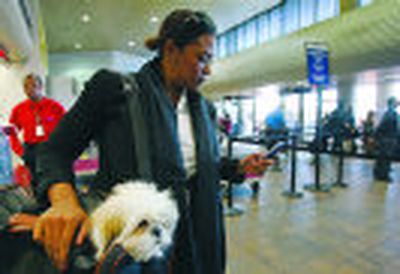
SuNae Martz is a 10-year-old jetsetter who’s crisscrossed the globe more than once.
The catch: SuNae is a dog – a fluffy white coton de tulear, to be exact.
Her owner, Gayle Martz, takes her everywhere she flies, from Paris to New York to Los Angeles. But SuNae doesn’t fly in the belly of the plane like common cargo. She’s first class, in the cabin under Martz’s seat.
“I don’t check my jewelry, and SuNae is my most precious jewel,” says Martz, a former flight attendant-turned entrepreneur who created and sells a soft-sided pet carrier, the Sherpa Bag.
SuNae is one of a half-million pets that fly each year, according to statistics compiled by the U.S. Department of Transportation. But not all airlines permit pets to fly in the cabin, and other policies vary, too.
Some airlines restrict the travel of short-nosed animals, like Persian cats and pugs, which have shorter nasal passages that make breathing difficult at higher altitudes. Most also don’t allow pets to travel as cargo in temperatures below 20 degrees and above 85 degrees.
Federal officials began making pet-related travel statistics public last year for the first time as part of regulations imposed by the Safe Air Travel for Animals Act, which was passed by Congress in 2000 under pressure from animal rights activists.
Most air trips with pets are without incident. There were 14 reported pet deaths, four injuries and six lost animals between May and September 2006.
Most mishaps, according to the American Veterinary Medical Association, stem not from mishandling or a panicked animal getting injured or lost but from sedation. The AVMA advises against giving tranquilizers to pets during air travel because the results are often unpredictable, even fatal.
“An animal’s natural ability to balance and maintain equilibrium is altered under sedation,” says Dr. Patricia Olson, former director of veterinary affairs and studies for the American Humane Association.
“When the kennel is moved, a sedated animal may not be able to brace and prevent injury.”
Continental requires passengers to sign a waiver saying their animal has not been sedated, but most airlines don’t have that rule.
All these different policies can be confusing.
“It seems like it all depends on the mood of the person you’re dealing with at the airport that day,” says Eric Buss, a magician from Los Angeles who has traveled by plane with the doves and rabbits he uses in his act.
Here’s what you need to know about flying with your pet:
“Most airlines require pets to be considered healthy, under 100 pounds and at least 8 weeks old.
“Pets are never allowed out of their containers, and, of course, the airline assumes no responsibility for their health and well-being. (Many even state on their Web sites that crew members cannot perform lifesaving measures on ailing pets.)
“Less traditional pets aren’t allowed at all, like potbellied pigs, primates and certain venomous reptiles. And that usually means no “snakes on a plane.”
“The U.S. Department of Agriculture, which regulates pet air-travel, requires a health certificate from a vet 10 days before traveling for animals flying as cargo, but not when flying as checked baggage or carry-on. Martz suggests carrying such certification in any case just in case you are asked for it.
“Many airlines, including Continental, United and American, suggest and apply the certification even for pets transported in the cabin because some states require it. (To learn which ones, visit www.aphis.usda.gov/vs/sregs/.) Health certification is also required on most international flights.
“Fees vary. JetBlue and Delta charge $50 for a pet to fly in the cabin; Continental, $95, American, USAirways and Northwest, $80.
“American Airlines, Delta, JetBlue and many other airlines allow pets in the cabin. Frontier only allows them as cargo. Southwest won’t let pets fly at all (except for service animals).
“Some airlines only allow one animal in the cabin per flight. American allows up to seven per flight (not per person). Sometimes certified service dogs count as a pet; sometimes they don’t.
“American Airlines requires paperwork certifying that pets were fed and watered within four hours before delivery. Most don’t.
Of course, even when you take every precaution and follow all the rules, flying with pets can be challenging.
Jen Fromm, an attorney from Los Angeles who recently flew her cats from Boston, still has scars from where her cat clawed her in a panicked escape attempt while going through a security checkpoint. The cat didn’t get away, but he cried during the entire five-hour flight.
Fromm says she’ll never do it again: “I would rather drive with my cat for five days than go through five more hours of that.”