
Lenten rose a hardy perennial
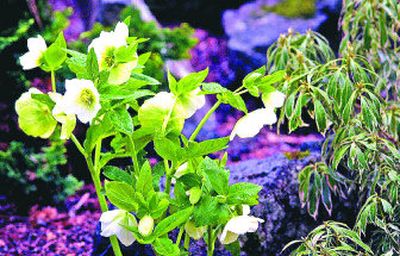
Helleborus orientalis may sound like a botanical mouthful, but this diminutive plant should be cultivated in every Inland Northwest garden.
Also known as the Lenten rose, hellebores provide the earliest blooms of the spring and their leathery evergreen foliage keeps landscape beds alive with color year-around.
My first Lenten rose came from my mother’s collection, and I thought I had something special until I toured Kevin Brownlee’s yard in the Nettleton’s Addition Historic District in Spokane.
Brownlee, who is probably the area’s top hellebore collector, said he was drawn to the plants while living in Seattle where they normally bloom during late winter, sometimes even during the dead of winter.
His passion for hellebores was so intense that he even imported a species variety from a Chinese professor – H. thebitanus.
A lot of gardeners will tell you that hellebores are hard to grow. Judging from the profusion of plants in Brownlee’s backyard, they apparently are not fussy. They thrive in our alkaline soil, and are cold hardy.
Brownlee’s collection includes flowers that are white, creamy yellow, green, pink, purple and even black. Some are speckled with a mix of colors.
Most of them are hybrids created by crossing different hellebore species found in nature. One of the species called H. niger is known as the Christmas rose for its habit of blooming in December. The flowers are white.
Another hellebore – H. foetidus – is known as the stinking hellebore because of the scent given off by its leaves when they are crushed.
The Lenten rose is native to a broad area of southern Europe from Greece to the Caucasus Mountains, and in parts of Turkey. In the wild they show a high degree of variation, although only three subspecies are recognized, according to authors Graham Rice and Elizabeth Strangman in “The Gardener’s Guide to Growing Hellebores.”
They seem to prefer moist deciduous or evergreen woodlands.
The Lenten rose is considered a perennial. It can grow to 24 inches in height, but most of the cultivars are shorter than that. They look best planted near borders or next to evergreen shrubs, including rhododendrons, azaleas, yews or arborvitae.
They will grow in the sun but prefer part shade. Sheltering them allows the carefree plants to thrive.
Once a clump gets established, it will spread easily by seed, but the expanding clumps may take years to become large enough to produce potential transplants. Old leaves should be cut back just before the new flowers emerge at this time of year.
Larger clumps develop thick rhizomes that can be easily divided with a garden fork and shovel.
Brownlee said that on big clumps, “The rhizome is so massive it’s hard to kill it.”
Now that’s a plant I can live with.