
Travertine’s timeless beauty
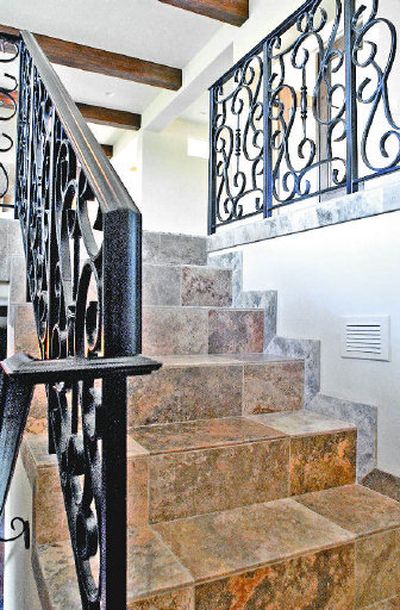
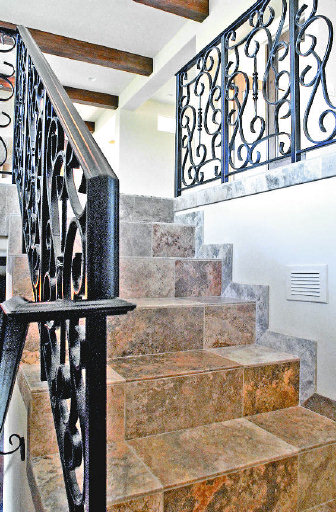
Travertine, a natural limestone which is marbled with impurities such as iron, is a natural choice for tiling bathrooms, floors and even kitchen countertops.
Travertine is a “beautiful and timeless choice,” says Lynnelle Caudill, General Manager of the Davenport Hotel and Tower. During the 2000 restoration of the historic hotel, travertine was installed in the Davenport’s rooms. Now, Caudill says, it’s been installed in the new Davenport Tower.
Caudill explains that the maintenance of the travertine is a fairly simple process which involves daily cleaning of the tile with one tablespoon of Simple Green mixed with a gallon of hot water.
Mitch Stark, Director of Engineering for the Davenport Hotel and Towers explains that the tile is also sealed once a year with TileLab Sealer, a fairly inexpensive (about $40 per gallon at Home Depot) sealer for tile and grout.
Tara Barnes, Account Manager for Mario and Son Inc., who specializes in granite, marble and heavy glass and was the main suppliers of the travertine tile for the Davenport’s restoration project, warns that travertine kitchen countertops attract stains simply because of their location. While oil-based stains are easily remedied by applying a poultice mixture that actually pulls the oil from the pores of the stone, other marks, called etching, left by acid-based products like orange juice, soda and ketchup are more problematic.
Acid-based products strip the polish from the surface of the stone, making it appear dull. Barnes says that there is no remedy for etching on travertine.
Barnes says to prevent damage to travertine kitchen countertops, reapplying a food-safe sealant every three to six months is essential. She also recommends always using cutting boards to avoid scratch marks in the stone.
According to Barnes, the beauty and appeal of travertine is that it cannot be highly polished as porcelain tile is. It has a more natural look. The most common complaint of customers is that the tiles do not exactly match in color. Barnes says that color variation in natural stone is normal and part of its appeal. She does caution consumers, however, to buy more than the amount that will be needed for the project, as it is difficult to go back and find a match.
Joe Mach, a flooring expert for Home Depot, recommends either 5-11 Impregnator sealant or TileLab sealer to seal travertine surfaces. He says the 5-11 Impregnator claims on its label that the sealant will last for 20 years. Mach says that a stone sealant, if originally applied in two coats, could probably last 20 years in residential use, but should probably be applied more often when the travertine is used in commercial projects such as the Davenport.
Caudill was able to use leftover tiles from the Davenport’s restoration project to tile her own bathroom, kitchen floor and kitchen countertops. She recalls spilling an oil-based salad dressing on the countertop, which created a large, dark stain. She had the installer come out and apply a product to the spot to remove the stain.
For Caudill, the decision to use travertine to tile the bathroom walls and floors in the Davenport and in her own home was simple.
“It won’t have to be replaced every five years,” Caudill says. “Travertine is timeless.”