
Advocates for the elderly
Nita Jensen strode down the halls of Alderwood Manor in south Spokane, clipboard in hand. The perfectly coiffed senior in a striking pink jacket isn’t employed by the long-term care facility, nor is she a resident. She is a volunteer with the Washington State Long Term Care Ombudsman Program.
“I do this because I have a lot of compassion for people,” Jensen said. The ombudsman program is mandated by the Federal Older Americans Act to “improve the quality of life for people who live in licensed long-term care facilities.”
That lofty mandate has a much more down-to-earth reality. The ombudsmen are the residents’ advocates and, many times, their friends.
Jensen quickly made her way to Evelyn Fossier’s room. Fossier is a Katrina refugee who fled the hurricane to visit her son in Spokane, only to take a bad fall, severely breaking her leg. The two ladies spent time laughing and catching up. “She’s anxious to get out of here and do her own cooking,” said Jensen. “I cook Creole, not Cajun,” Fossier added with a grin.
According to Linda Petrie, the Eastern Washington ombudsman since 1990, the program currently has about 30 trained volunteers. “We serve a five-county area,” Petrie said. This includes 29 nursing homes, 62 boarding/assisted-living homes and 200 adult family homes. The need for more volunteers is urgent.
At Alderwood, Jensen said goodbye to Fossier and made her way to 51-year-old Michael Durham’s room. “He’s my favorite guy here,” Jensen whispered behind her hand as she entered his room. It was easy to see why. The soft-spoken man with a sweet smile warmly greeted his visitors with an offer of chocolates. He pointed to a jar filled with candy. “We’ve got a nice little routine going on here,” he quipped. “The aides come in here and grab a treat and I get special treatment.”
Jensen describes her role as being in the first line of advocacy. An ombudsman is a trained volunteer who listens to concerns and questions and works with residents, families and staff to resolve problems. Petrie said, “We make sure residents have the highest quality of life.”
Across town at Avalon Care Center at Northpointe, ombudsman Irene Martin checked in on Marion Deeter. Deeter’s bed overflowed with stuffed animals. “I’m in my second childhood,” the feisty senior said with a chuckle. Deeter looks forward to Martin’s regular visits. The two bantered and teased each other.
Martin grew serious when she talked about her role as an ombudsman. “Most folks just want somebody to talk to,” she said. “So many people don’t have families to visit them.” She paused, looking out a nearby window. “You learn what old age, sickness and accidents are all about.”
Petrie said that educating residents, family and facility staff about resident’s rights is a vital function of the ombudsman program. “More importantly, they empower residents to act on their own behalf.”
Frank Felchlin is doing an internship at with the program. He’s overseeing the 200 adult family homes in the five-county area. “Ombudsmen wear many hats,” he said. “We end up being educators, facilitators and problem solvers.”
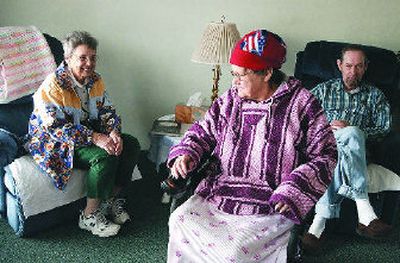
Many people choose adult family homes instead of larger facilities because they enjoy the feeling of living in a home. Ombudsman Edwes Wille makes regular visits to Carol’s Care Adult Family Home in Spokane Valley.
The cozy living room in the home on East Mission Avenue had a hunting lodge ambience because of the stuffed, mounted bighorn sheep trophies that lined one wall. They belong to a 95-year-old resident.
A few folks gathered to chat with Wille. Later she’ll visit the rooms of several others. “As I grow older, it’s a way for me to keep active and be involved, instead of sitting around watching TV,” Wille said. “I wouldn’t do this if I didn’t think it was a help to the community.”
Resident Richard Stickler said he looks forward to her visits. “I’m not much of a talker though,” he said with a shy smile.
For Felchlin the ombudsman program is meaningful work. He said, “It’s a thrill for me to be an advocate for a vulnerable adult population – to help them be less vulnerable.”
An upcoming four-day certification training is a great way for the community to learn more about this vital program. Ombudsman Nita Jensen said, “So many people don’t know about what we do, and that’s a shame.”