
Artificial patients never die, and never sue

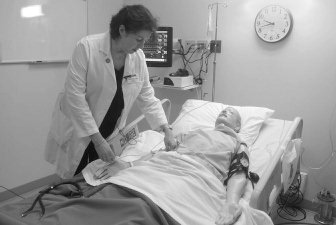
SALEM, Ore. – Pat Hertz, of Salem, lies in a lonely hospital bed day after day.
Sometimes he feels better, sometimes worse.
He coughs and wheezes at times, his breath coming in ragged gasps.
“Doc, I feel like I could die,” he says in a canned voice. “Oh, I’m so sick.”
With a simple change of some anatomical parts and a wig of straight black hair, Hertz becomes Montana Sutton.
Hertz and Sutton are high-fidelity manikins – not to be confused with differently spelled department-store mannequins – that can breathe, talk, be poked and prodded and given shots.
And most importantly, it’s difficult to kill them.
“They’ve been using these in nursing schools for about five years now,” said Sally Jasper, the simulation lab coordinator for Chemeketa Community College.
The main purpose of these talking, breathing, mechanical beings is to help nursing students learn how to deal with situations that they might face in a hospital.
“A patient may be getting short of breath,” Jasper said. “The students will have to listen to the lungs, decide on medication or whether to call the doctor.”
Hertz and Sutton found a home in the simulation lab at Chemeketa Community College more than a year ago.
The state-of-the-art manikins cost about $28,000 apiece.
Jasper said a committee applied for and received a grant from the Department of Labor to cover the cost of manikins and lab construction.
Several classrooms and offices were converted into a simulation lab, which opened to students in November.
“This gives students a safe situation where they can work without actually hurting anybody,” Jasper said.
The students participated in a contest to decide the manikin’s names.
Perhaps the greatest benefit of the manikins is their ability to exhibit a variety of illnesses.
And Jasper gets to play God in the control booth, affecting both the student and the manikin.
She can tailor the simulation to cover all aspects of a trip to the hospital.
“We’ll have a visitor sitting next to the bed,” Jasper said of the small room decorated to look like a hospital room. “They might be anxious, or try to interfere with the nurse, and all the while the student must keep an eye on the monitor, on the oxygen and the temperature.”
The manikin comes with canned responses and general complaints, but when Jasper really wants to throw a student a curve ball, she can simply sit in the control booth and talk for the manikin.
Jasper can argue with students, give symptoms, talk about pain or any possible medical scenario, which becomes valuable experience for students who might not experience all the scenarios until well into their nursing careers.
“As we see students who’ve used the high-fidelity manikins, they totally get it,” said Jeanine Bauer, the surgical services clinical educator at Salem Hospital. “They are more eager to jump into any situation.”