
Mount Rainier park reopens
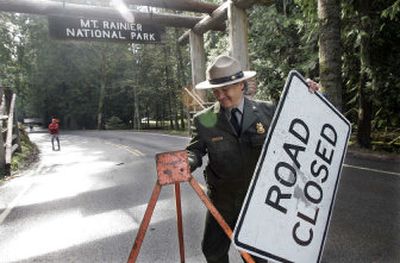
MOUNT RAINIER NATIONAL PARK, Wash. – The road to Paradise reopened Saturday.
Six months after November floods ravaged the main road in this park in the Washington Cascades – along with campgrounds, trails and the wild country in general – the road to Rainier’s main visitor center reopened at 9:37 a.m.
An hour beforehand, more than 100 cars and trucks were lined up outside the park’s Nisqually entrance, The Olympian newspaper reported.
“I’m going to get up to Paradise, set up my tent and go up to Camp Muir for the day,” Curtis Plumb said as he readied his 44-pound backpack. “Then I’m going back down to Paradise and stay the night.
“Yeah, I’m excited to get up there.”
In a brief reopening ceremony, Congressmen Norm Dicks and Dave Reichert talked about the hard work it took to reopen the park – and the work that remains.
“We hope to see lots and lots of you here this summer,” said Jay Satz of the Student Conservation Association, which is helping to organize volunteer work crews at the park.
Not all of the damage caused by the heavy November storms is yet known, because snow in the high country won’t be melted until mid-July.
Nearly 18 inches of rain fell in just 36 hours last fall at Mount Rainier, which draws 1.5 million visitors annually. The deluge left an estimated $36 million in damage, fractured miles of roads and trails and forced the closure of one of the Pacific Northwest’s crown jewels for the first time in a quarter-century.
Park Superintendent Dave Uberuaga had said earlier that “every road, every campground, every trail throughout the park was damaged to some extent.”
Crews have restored utilities to the park and repaired the Nisqually Road to Paradise.
Visitor centers and services will be open at each of the corners of the park, but visitors who expect to be able to drive through and stop at each will be disappointed. The Stevens Canyon Road could remain closed or restricted to one lane all summer.
And north-south section of Highway 123 will be shut down at least until fall, as engineers haul 55,000 tons of rock – an estimated 1,800 truckloads – into the park to rebuild the road.