
Going beyond the book
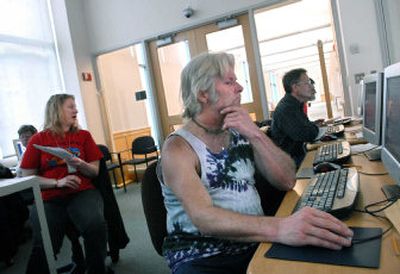
If you’re the betting kind and someone says libraries will be killed off by Google, take the wager. Web search engines do find tons of information. But the public library, say many of its advocates, is nowhere near extinction.
Like libraries elsewhere, Spokane’s two public library systems – operated by the city and by Spokane County – have shifted huge amounts of information to their online databases. For specialists and data-hunters, those online resources – available free with a library card – are sharp-edged tools for cutting through clutter to find reliable information.
Libraries, however, need to do their job better, librarians agree. Spokane’s public library online databases are not widely known in the community.
“We haven’t done a great job yet of promoting the online databases we have,” said Dennis Fredrickson, manager of the city’s downtown library.
Usage has been increasing. In March 2007 the city had 6,260 online database sessions, compared with 5,440 the month before.
The most common users are students, genealogy researchers, mechanics, do-it-yourselfers and business owners logging on to find something specific to their needs, said Fredrickson.
One area business now using the online resources is Spokane’s office of Accountemps, a nationwide staffing company. The firm’s division manager, Dianne LaValley, became a convert to the city’s databases when she met with a group of downtown businesses earlier this year.
She discovered the advantages of using the city library’s ReferenceUSA database, which tracks information on businesses across the country. She used ReferenceUSA to find out how many CPAs are within a 50-mile radius of downtown Spokane. That database, developed by data provider InfoUSA, found about 500 CPAs in that group – along with exact addresses and phone numbers.
A Web version of ReferenceUSA is also available at a cost; but the library version, paid for with city money, allows city residents full access free of charge.
“We’re in the business of creating jobs,” said LaValley. Once she saw how quickly ReferenceUSA finds businesses in any sector, she had the library come to her company office and present a demonstration. Her staff all signed up for library cards later that day, she said.
ReferenceUSA is also available through the Spokane County Public Library.
Other popular databases available through both libraries are ProQuest, a collection of articles printed in newspapers and magazines; HeritageQuest, a vast compendium of historical data used heavily by family researchers; and Health and Wellness Resource Center, a medical encyclopedia.
The city also offers InfoTrac, another large collector of materials found in newspapers and magazines. Like the other databases, InfoTrac is constantly updated by its provider. Most of those databases are also available at nearly every North Idaho public library, said Bette Ammon, the Coeur d’Alene city library director.
As more money goes to online tools, Spokane’s library materials budget keeps shrinking. In 2005 the city spent $914,610 on new materials. In 2006 it fell to $827,914.
Joe Janes, a professor in information science at the University of Washington, said local public libraries are dealing with the same fast technology changes the rest of society is encountering.
Libraries play a key role by helping to remove clutter and junk information from what people are now able to find at their fingertips.
“In addition libraries have trained and experienced people, who provide guidance when people want relevant information,” said Janes.
Still, Janes admits Google has an advantage, because it’s simpler to use than the screens and interfaces libraries now have. Librarians and users need to change the interface by which people use public library databases.
“Trying to beat Google at what it does is a fool’s errand,” Janes said.