
Pruning riles residents
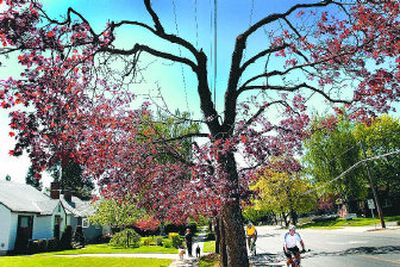
Majestic old trees lining some of Spokane’s shadier streets are being pruned so severely that some residents are calling it butchery.
The middles of 17 trees along the east side of Grand Boulevard north of 37th Avenue were hacked away in an ongoing effort to clear vegetation away from power distribution lines.
Other trees are being trimmed near 31st Avenue and Division Street.
Two years ago, crews worked on clearing tree limbs on the North Side.
“I called it butchery,” said Jim Parry, a resident of the North Hill neighborhood.
Avista Corp. said it has hired a contractor to prune the trees to protect the safety of line-maintenance workers as well as reduce the number of power outages caused by falling limbs. Avista spokeswoman Debbie Simock said falling trees are the top cause of outages.
State law requires 10 feet of clear space around electrical lines. “That’s for the safety of those who work on the lines,” she said.
Simock said Avista is seeking to trim trees every five years but hasn’t kept up with pruning over the years. As a result, a lot of trees along power lines have gotten too large and need severe pruning.
Branches have been cut out of most of the trees’ middles to create the 10-foot zone.
“It’s like they put a big ‘V’ in the tree,” said Susan Thompson, who lives east of Grand Boulevard, where trees in her neighborhood have been pruned. “I think it’s going to kill the trees,” she said.
Jeff Perry, arborist for the city of Spokane, said he’s been in touch with Avista and its contractor, Asplundh, about appropriate tree trimming. He said some of the cuts are so dramatic that the trees probably will grow back with bushy growth.
Perry also said other trees probably need to be removed and replaced. He said he is going to ask Avista to pay for some removals along Grand Boulevard and for replacement trees.
A public meeting may be scheduled prior to any removals, he said.
“We are right in the middle of discussing how we are going to take care of this situation,” Perry said.
The problem stems from the fact that large trees mistakenly were planted in parking strips and along streets about a century ago. Smaller trees such as hawthorns or American hornbeams would be more appropriate for planting beneath power lines, Perry said.
Asplundh’s workers, he said, have been doing a good job with their pruning, but the problem is the amount of wood being removed from some of the trees, he said.
“Asplundh is doing the best they can with what they have to work with,” Perry said.
Asplundh has a city permit for the work.
Perry said regular pruning every five years would be better since it would lessen the need for dramatic pruning and allow trees to be trained away from power lines.
Simock said the utility is aware that people are emotionally attached to their trees.
“We are sensitive to how people feel about the trees,” she said. “Trees and power lines can coexist.”
When a crew was working on the North Side in 2005, Parry complained about the cutting and met with Avista officials and a representative of the contractor.
“We were not happy with the overall results and their attitude toward us,” Parry said. He added that one of the locust trees that was pruned may have died since then.
“It seems like there should be a better way,” he said.