
Students get their hands wet

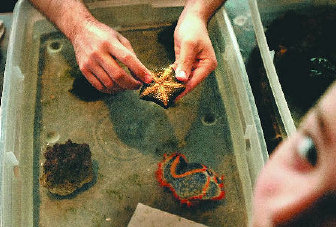
Feeling the snail in the touching tank elicited a big “eeeuuuw” from Chloe Trowbridge.
“Cool,” said Aidan Jacobs as he put a small crab back in another touching tank. “The crab just pooped.”
Cool, apparently, is in the eye of the beholder.
But for all the Moran Prairie Elementary School kindergartners whose recent field trip took them to visit the 2,500-gallon saltwater aquarium at the nearby home of Helen and Roy Givens, it was an eye-opening and special hands-on experience that capped off their study unit on the ocean.
Each spring for the past five years, the Givenses have invited the children (and their teacher Debbie Smith along with several parents) for a field trip, to handle several nonfragile species that are placed in touching tanks for the day, hear stories about the ocean and learn about the aquarium.
And it’s no ordinary aquarium. Serious hobbyists may have aquariums up to about 230 gallons, but Helen Givens’ fascination with things oceanic is huge – and resulted in the 2,500-gallon aquarium that her husband designed, engineered and built five years ago.
It and its supporting pumps and other equipment take up an entire wall of their family room. The tank is 9 feet by 7 feet and is surrounded by cherry panels that conceal all the supporting structures, lights, filters and a churner and cooler to simulate the ocean.
The aquarium contains some 70 fish (40 different varieties), 40 varieties of coral and an assortment of clams, anemone and snails. The newest additions are a rare blue-carpet and red-carpet anemone and a 3-foot-wide gigas clam, which weighs 300 pounds. Specimens come from Bali, Hawaii, Mexico, Fiji and other faraway places.
As the children sat in front of the big aquarium to learn that the ecosystem needs vitamins and disinfectants, just as people do, they were quick to spot the percula clownfish, the Pacific (regal) blue tang and the Hawaiian yellow tang (also known, respectively, as Nemo, Dory and Bubbles from the film “Finding Nemo.”)
Stephanie Hyta and Allison Butterfield jumped up and down shouting that they had found the blue starfish after Helen Givens had challenged them to see if they could spot it.
Over at the touching pools, Katie McCune wanted to know what kind of clam she was holding, noting that her brother Curt, now a third-grader, had visited the aquarium when he was in kindergarten.
Lindsay Baalkenbush suggested she wouldn’t mind seeing a fish get eaten by a sea anemone. Nicholas Joss said the pillow starfish might look like a pillow but its rough surface sure didn’t feel like one. They all seemed to know that clownfish are safe from – and actually hide in – anemones (thank you, “Finding Nemo.”)
In the living room, the Givenses’ daughter, Madison, 13, a seventh-grader in the Odyssey program for gifted children at the Libby Center, read ocean stories to a small group of kindergartners. That has been her role since the field trip experience began five years ago.
Family friend Mike Bradley, a pre-law student at Eastern Washington University, handled specimens at the touching pools and told the children about each one. “It’s an addicting hobby,” said Bradley, who has four (much smaller) aquariums of his own.
Roy Givens, who owns Pantrol electrical engineering manufacturing company in Spokane, said he doesn’t much care for fish himself. He was quite content to remain in the outdoor activity center – on other days known as his “train garden” – where groups of kindergartners circulated through to view the workings of his three G-scale model trains and their 600 feet of tracks.
Yes, he said, he and his wife definitely are hobbyists; they just have different tastes in hobbies.
But one train detail didn’t escape the eye of kindergartner Matthew Hiller. He spotted the side of one of the boxcars that contained a “Finding Nemo” ad and had a percula clownfish perched on top.
As the children went from one activity center to another at the Givenses’ home, Helen Givens, a former school counselor who grew up near the Oregon coast and began her love affair with the ocean there, said she loves providing this field trip experience and hopes to encourage the children to get excited about aquariums or most any other kind of hobby.
She said she also hopes to encourage other people who have interesting hobbies or collections to work with their neighborhood schools to share them with the children.