
WSU pitches its inventions at event
A vaccine against solid cancers might someday be possible based on a Washington State University researcher’s study of an unusual gene.
But developing such a product would take more years of work and millions of dollars of investment, WSU associate professor J. Suzanne Lindsey told potential investors Thursday afternoon in Spokane. Her presentation was part of a first-ever event by the Washington State University Research Foundation and Greater Spokane Inc. designed to promote “technology transfer” – connecting WSU faculty with business people who can get their ideas to the marketplace.
Lindsey and four colleagues pitched their work – ranging from a device to improve home ventilation systems to nanotechnology that could aid development of hydrogen-powered cars – to more than 40 people at the Riverpoint campus.
While any money from licensing or forming a business around the research would be split among the research foundation, WSU and the professors, looking at tech transfer as a money-maker is a mistake, said Keith Jones, director of WSU’s Office of Intellectual Property Administration.
“Financial impact would be nice down the road, if it happens,” Jones said.
A nonprofit organization, the foundation provides research funding to some faculty members, and it helps handle the business end of developing technology.
It has stepped up its efforts in the last two years, and it now issues about 10-20 licenses a year, Jones said.
Attorney Norman Jangaard attended the event to see professor Norman Lewis’ presentation on creating custom plants that make chemicals useful for biofuel additives, food additives and plastics.
Jangaard said he has helped large corporations, such as Monsanto Co., acquire technology, and he has led biotechnology firms.
He also worked on tech transfer events for the University of California, and they do “fairly frequently” lead to development, Jangaard said.
“It’s good to see your ideas come to commercial fruition,” he said.
The researchers struggled to condense their complex work into 10- to 15-minute presentations.
Lindsey is researching “Mig-7,” a gene she thinks is specific to cells caused by aggressive solid cancers, such as uterine, ovarian and prostate, that can spread throughout the body. Her discovery might help doctors find cancer that goes undetected today, she said. Patients might be able to get a simple blood test to determine if cancer is circulating in their blood, she said.
By prohibiting expression of the gene, her discovery also might lead to a treatment that, unlike radiation or chemotherapy, doesn’t target normal cells, Lindsey said. It might be developed into a cancer vaccine, but that might be off-limits to child-bearing women because Mig-7 is found in certain fetal cells, she said.
Other professors offered simpler ideas.
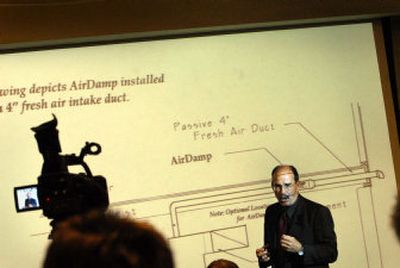
Holding a prototype of his AirDamp device, which resembles a bathroom fan stuck in a black box with two transparent cylinders protruding from each end, construction management professor Max Kirk said he foresees a “huge market” for his invention – but he lacks the business know-how to market it.
While building codes require certain air flow rates for newer home ventilation systems, many systems are ineffective, and people in cold climates sometimes block them to prevent freezing, he said.
The AirDamp forces air into the system when the furnace runs, and it seals off a home’s air duct when not in use. It’s also energy efficient, potentially saving users’ heating costs, Kirk said.
“When I came up with this invention, the patent attorneys all looked at it and said, ‘There’s got to be a million of these,’ ” he said. “They kept looking and came back, and they said, ‘You invented the paperclip,’ ” Kirk said, adding that his patent includes 27 claims.
Professor M. Grant Norton, of the School of Mechanical and Materials Engineering, presented GoNano Technologies, a collaboration between WSU and the University of Idaho that has produced a patent-protected method for creating nanomaterials that could be used to store hydrogen.
Another presentation centered on making custom plants that produce useful chemicals and transforming agricultural waste into fuel and other useful products.