
Antique pistol adds value with age
Dear Collector,
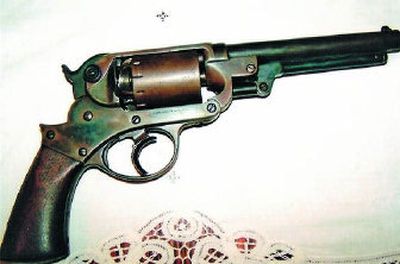
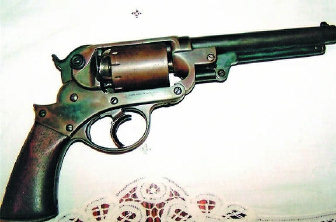
My grandmother gave this gun to my husband years ago. She thought it was from the Spanish-American War. On one side of the revolver, above the trigger, it has “Starr Arms, New York.” We would appreciate any information, including its value?
Manufactured in limited numbers (about 3,000) between 1858 and 1860, your double action percussion pistol would have been outmoded by 1899; so it’s unlikely it saw service in Cuba. Not as well-made as the Remington and Colt, both of which were also used in the Civil War, this .36 caliber sidearm originally sold for about $20. There should be military inspection marks on your pistol, which would definitely prove its provenance. Interestingly, the company’s founder, Ebenezer Townsend Starr, was a third generation arms maker with antecedents to the Revolutionary War. Today, the value on your gun is around $2,000.
Dear Collector,
Enclosed is a photograph of a Roseville pedestal and jardinière marked “632-10.” They are in excellent condition and have no blemishes whatsoever.
From Roseville’s 1935 Pine Cone line, this set in brown is listed in various guides at between $1,800 and $4,000. I think the lower figure is the more accurate, since these items can be found on eBay for around $1,500.
Dear Collector,
Is this “Casper” comic book valuable? It was among some magazines that I was throwing out.
The full title of your 1951 St. John Publishing Co. is “Casper, The Friendly Ghost.” I found this very fine condition comic listed for $300.
Dear Collector,
During a recent road trip, I stopped at an antique store where I saw an old chair with an embroidered seat and back. The store’s owner said this kind of needlework was “Cruel Work.” I didn’t want to show my ignorance so I didn’t ask her what she meant by this expression. Can you explain what she meant?
While you heard it right, you spelled it wrong. Crewel (origin of the word is unknown) stitching is “loosely twisted worsted yarn used for fancywork and embroidery,” and saw its first popularity in the 17th century. It was resurrected in the Victorian Age, which is probably when the chair in question was decorated.
Dear Collector,
This “Marx & Gutherz” vase has been in our family for at least fifty, maybe one hundred years. It has no chips and seems in perfect condition. Can you tell me something about it?
The first thing I can divulge is that you have a covered sugar bowl, not a vase. Made in the 1890s, this porcelain piece came from Altrohlau, Bohemia (now in the Czech Republic), and is worth $20-$25.
Dear Collector,
Years ago I unearthed a “Calisaya Bitters” bottle when excavating for a pool. Can you tell me what this was used for, and how much the bottle is worth?
Made from the bark of a Peruvian tree containing quinine, this stomach medicine or digestif is still in use today. Without photos or further information, there’s no way I can give you the bottle’s value.