
Focus on al-Qaida as Padilla trial starts
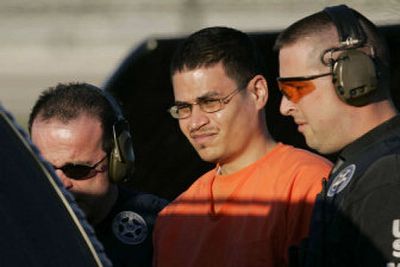
MIAMI – After Jose Padilla was arrested five years ago as the “dirty bomber,” his mug shot, tanned and glowering, became the face of domestic U.S. terrorism.
But as his trial on charges of participating in a “conspiracy to murder, kidnap and maim” opened here Monday, the case against the former Taco Bell worker and convert to Islam has shifted and shrunk, reflecting the Bush administration’s difficulties in pursuing terrorism suspects.
In the case presented to the jury, Padilla is no longer alleged to have plotted to set off a radioactive, or “dirty,” bomb. Nor is he alleged to have played a role in any other specific violent plots, in the United States or anywhere else.
Prosecutors instead repeatedly emphasized their belief that Padilla and his two co-defendants formed a South Florida “support cell” that had ties to al-Qaida. Again and again, prosecutors invoked the terrorist group’s name in their hour-long opening arguments – by one defense account, 91 times.
“Jose Padilla was one of the recruits,” Assistant U.S. Attorney Brian Frazier told the jury. “We will prove he was an al-Qaida terrorist trainee.”
Defense attorneys responded by suggesting that because the prosecution case lacks specifics, prosecutors were relying on scare tactics – the “politics of fear” aroused by baseless links to the terrorist group – to persuade the jury.
“Jose was not a member of any support cell because there was none,” one of his attorneys, Anthony Natale, told the jury. “He was not a party to any criminal attacks. … there are no victims to speak of.”
After he was arrested in May 2002, Padilla became the most prominent of the Bush administration’s terrorism suspects because of the president’s decision to detain a U.S. citizen militarily as an “enemy combatant.” Once the Supreme Court seemed to tilt against that tactic – 3 1/2 years later – the administration moved him to the civilian justice system.
Since Padilla landed in criminal court in January 2006, the prosecution seems to have faltered.
Now, the essence of the allegations against Padilla is that, with the support of the South Florida support cell, he attended an al-Qaida training camp in Afghanistan in July 2000.