
Homestay builds cultural ties
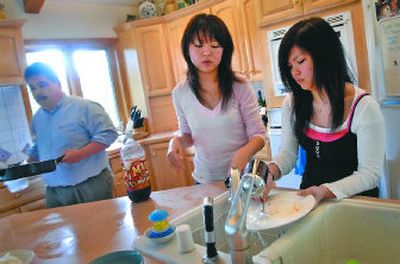
“I like the idea of a connection between people in different parts of the world,” said Polly Kaczmarek.
She and her husband, Ed, have found a way to make that connection through a program known as Homestay. Like dozens of others in the Spokane area, the Kaczmareks open their home for a short-term visit from students at Mukogawa Fort Wright Institute in northwest Spokane. “It’s simple – a way to help people understand people of other cultures,” she said.
One weekend during each semester, Mukogawa sends their Japanese students into selected homes for an immersion in American culture. The students, all enrolled at Mukogawa Women’s University in Nishinomiya, Japan, become part of an American family for that weekend. They participate in whatever activities the family might plan – gardening, sightseeing and shopping, for example.
In the Kaczmarek household, Ellen, 11, and Paul, 7, help teach their new “sisters” American card games. Later, Mio and Rumi turn the tables and demonstrate Japanese games and origami paper crafts.
The family also spends time exploring the Spokane area with their host daughters. “We take them to Riverside State Park, to Manito Park and the Japanese Gardens,” said Polly, remembering their recent Homestay weekend. “Back at the house, we made s’mores in the fireplace. It was fun to give them these experiences.”
Other families echo the Kaczmareks’ joy in welcoming Japanese students. Ken Binion and his wife, Marilyn, have been host parents for years – originally with student exchange programs in California, and now with Mukogawa. “We just really enjoy young people,” said Marilyn, a retired attorney whose own children are grown. “We enjoy learning about their culture and helping them learn about ours.”
She said the Mukogawa students are “fine young ladies” with good English skills. “They’re really interested in learning about America. This is an important experience for the students. We want to support that.”
Bob and Jill Kang of Spokane Valley agree. “The girls are so sweet, gentle, smart and curious,” said Jill. “We learn about their country and customs. We laugh a lot together.”
Since moving here from Seattle in 2001, the Kangs have served as Mukogawa host parents several times. In fact, these empty-nesters became such fans of Japanese students that they did Internet research and found a high school exchange program. Last fall they welcomed a student into their home for the entire school year. Miki, from Sataka, Japan, attends University High. “This house feels like family to me. I am comfortable here,” she said.
Like the Kangs, other Homestay participants have discovered a growing interest in the international culture. Middle-schooler Ellen Kaczmarek now studies the Japanese language in an after-school program, and she’s learning Kendo, a Japanese martial art. All this came about, according to her mother, as a result of the family’s hosting Mukogawa students.
Many host families believe their Homestay role has expanded their perspective on life and international relations.
“Every time they understand more about us, and we understand more about them, we see that all humans are basically alike,” observed Marilyn Binion. “We have the same basic feelings, wanting to have a life that’s productive, full of friends and family.”