
Secrecy of treasure find leaves many skeptical

Deep-sea treasure hunters said Friday they have recovered what could be a record haul of gold and silver coins from a Colonial-era shipwreck – but their failure to provide many details has set off a galleon-size controversy over their claims.
The hunters from Odyssey Marine Exploration Inc., a Tampa, Fla.-based company, said their haul has so far totaled about 17 tons of coins, more than 500,000 in all.
Each coin could bring between a few hundred and several thousand dollars, according to an expert who evaluated some of them at the company’s request. The total could reach $500 million, which would make it one of the most valuable sunken treasures ever discovered.
But some experts in nautical archaeology were quick to cast doubt on the value of the booty.
“There is no such thing as $500 million on any wreck in the world,” said Robert Marx, a veteran treasure hunter. “Anybody who says so is … lying.”
George Bass, an archaeologist at Texas A&M University who specializes in shipwrecks, said he is skeptical of these types of early estimates, especially when such little information has been provided by the company.
“Very often, it’s exaggerated because of course they need to get financial backers,” he said.
Odyssey Marine Exploration is unusual in the treasure-hunting world. It is a company whose stock is publicly traded on the American Stock Exchange.
On Friday, its shares, which had been hovering around $4, shot up 80 percent to close at $8.32. It rose to $8.94 in after-hours trading.
Odyssey co-founder Greg Stemm said the company is being “relatively secretive” while it confirms the identity of the ship.
Since September, the company has filed a series of motions in U.S. District Court for the Middle District of Florida for a summary judgment giving it the rights to an “unidentified, shipwrecked vessel.”
The documents say the wreck was found last summer 40 miles off the southwestern tip of England. It was a 17th-century merchant vessel equipped with cannons. Stemm would neither confirm nor deny that the filings refer to a new discovery.
The company announced the find with scant details, explaining that the wreck was found in international waters somewhere in the Atlantic. They code-named the site Black Swan.
Stemm said historical records show that several ships sank in the same region and that the company is still trying to confirm the identity of the wreck. They found the treasure using a deep-sea robot equipped with cameras.
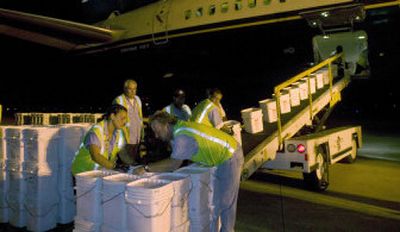
The company provided a photograph of hundreds of large white plastic buckets stacked on wooden pallets in a warehouse. Each is bucket is numbered and labeled with the weight of its contents. In the foreground, an 18-kilogram bucket is opened to reveal shiny silver coins.
Rare coin expert Nick Bruyer recently traveled to inspect the coins as they were going through the conservation process and declared the size of the find “unprecedented.” The coins spanned several decades and were exceptionally well preserved, he said.
Bruyer and Stemm refused to give the nationalities of the coins, but Odyssey has already begun marketing them on a Web site, www.blackswanshipwreck.com.
It is not the first discovery for the company. Odyssey Marine Exploration was founded in 1994 by Stemm and John Morris, who believed that modern technology would make it possible to recover valuable shipwrecks in deep waters, where they have been largely undisturbed for hundreds of years. The company went public in 1997, using money from investors to finance its discovery efforts.
Progress was slow, but in 2002 the company signed an agreement with the government of the United Kingdom to explore the wreckage of the HMS Sussex, an English warship that sank off the coast of Gibraltar in 1694. The gold on board has been estimated to be worth as much as $4 billion. Odyssey and the British government will split any proceeds.
In 2003, the company began to recover coins from another wreck, the steamship SS Republic that sank off the coast of Georgia in 1865. Odyssey has sold one-third of the coins so far for a total of $33 million, Stemm said.
Still, the company lost $19 million last year, according to filings with the Securities and Exchange Commission. Stemm said it costs $1.5 million a month to keep Odyssey’s research vessels working.