
Texas, a hotbed of skiing?
FORT WORTH, Texas — When summer hits the parched, flat prairie here, temperatures can spike to 100 degrees and firefighters get busy responding to the grass fires that routinely flare. To Charlie Aaron, it’s a perfect time to go snowboarding.
Mr. Aaron and several investors have ambitious plans to build a 25-story mountain with slopes for year-round, outdoor skiing and snowboarding. Surrounding the mountain will be an “Alpine Village” with chairlifts, ice rinks, a bobsled track, a winter wonder-park for children, a retail center, a 600-room hotel and a convention center. Total cost of the proposed Bearfire Resort: $696 million.
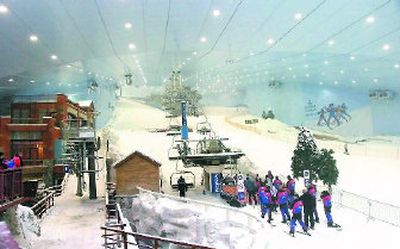
Bearfire is just the latest outdoor leisure venture to make a giant bet on defying nature in wildly improbable places. Dubai, in the Persian Gulf region, has an indoor ski dome that is part of its Mall of the Emirates. It plans to open another next year that revolves and has polar bears. A $35 million artificial whitewater-rafting center opened outside Charlotte, N.C., in September.
But even Bearfire’s investors acknowledge that people are skeptical about summer skiing in Texas — outdoors on artificial slopes that are without snow and aren’t even cold. “There are some naysayers and people who can’t really wrap their brain around it,” says the 53-year-old Aaron, president of the investor group. Originally from San Francisco, he has spent most of his career in sales, marketing and public relations. “They have the same questions that everybody else has, because it’s really incongruous, is it not?”
He insists the nearly six million people who live in metropolitan Dallas-Fort Worth, will find, in winter too, that it is easier and cheaper to ski Bearfire Mountain than to fly 700 miles to Colorado. Texans made up 6.5 percent of all visits to Rocky Mountain area ski resorts last year, second only to Coloradans, according to a survey by the National Ski Areas Association, a trade group in Lakewood, Colo.
The technology that makes it possible, which is known as Snowflex, uses water-misting systems to create a nonrefrigerated surface — think of wet, white Astroturf with bristles — that is slippery enough for skiing but with enough grip for turning. A few Snowflex slopes are operating in Europe, including one that is open year-round in Noeux-les-Mines, France. It is built on old coal-mining slag heaps in an area near Lille that isn’t naturally conducive to skiing.
But this is Texas, so it must be bigger. With 650,000 square feet of skiable surface, the Bearfire slopes promise to be six times the size of the artificial slope in France. The mountain’s superstructure is supposed to rise about 240 feet and require 7,000 tons of steel.
Wendell Jacobson, an investor in Bearfire and president of Management Solutions Inc. in Fountain Green, Utah, a multifamily-residence management company, says investors will ultimately put up $150 million, and the rest will be borrowed. Jacobson said the Bearfire investors are exploring several financial alternatives and are contemplating hiring advisers from UBS and Merrill Lynch, among others. The group plans to open the resort in the fall of 2009.
Aaron has never been involved in a large-scale development project. He has brought in family-entertainment industry veterans, including the Baker Leisure Group, of Orlando, Fla., to pull together the business plan and Greg Damron Design Inc., whose resume includes the master plan of Universal Studios Japan, to design the resort.
Unlike existing domed ski resorts — including the one in Dubai — the winter activities at Bearfire will be outdoors. The polymer surface will feel cooler than the air in summer, but it won’t be cold. To battle the heat (in an area that had 43 days in which the temperature topped 100 degrees in 2006), the developers plan to install misters, shades and turbo-fans, to reduce the temperature by about 20 degrees where people are lining up.
Aaron says Bearfire’s consultants predict 2.4 million visits in the first year, but that the venture will still be profitable if the numbers come in 20 percent below that. To make a go of year-round skiing, Bearfire also will have to change the mind-set of the typical skier who is eager to hit the slopes in November but whose interest wanes with the first whiff of spring.
“I’m not convinced that people will have the desire to ski in the warm weather,” says William Marks, an analyst who follows ski-resort companies for JMP Securities. “Do they want to go on a ski vacation when kids are off playing baseball or soccer?”
Bearfire will face strong competition for local leisure dollars in summer. In addition to Major League Baseball’s Texas Rangers franchise and a minor-league baseball team (the Fort Worth Cats), the area has a Six Flags Over Texas amusement park and a giant water park called Hurricane Harbor.