
Ideas abound at growth workshop

Kootenai County must look to other fast-growing areas and steal ideas for how to deal with skyrocketing populations that affect everything from traffic to the West’s iconic charm.
That was a common theme Tuesday at a rare growth workshop, aimed at bringing local factions together to talk and brainstorm.
Although there were no hard answers, there were ideas – including charging a tax on real estate sales to help pay for needs such as roads, open space, conservation easements, land trusts and impact fees.
There also was a sense that perhaps compromise and collaboration is possible among people who are more accustomed to contentious and emotional debates.
“I don’t think anger was exhibited here today,” said Barry Rosenberg of Kootenai Environmental Alliance. “Everyone is trying to work together in a very rational way.”
His comments came after Linda Wilhelm, the Coeur d’Alene Association of Realtors vice president, asked the group to set aside the “undertone of anger” that is often associated with forums and similar discussions.
And that’s one of the very reasons the Coeur d’Alene Area Chamber of Commerce’s natural resources committee organized the daylong workshop.
Dennis Glick of the Sonoran Institute, which works with communities to incorporate conservation, assured the group that emotions and conflict are common when it comes to the complex task of trying to decide as a community how and where to grow and what land to protect.
Yet he said the good news is that it’s not too late as it is in some communities. He added that a workshop to bring a diverse group of residents together is a good start.
“You have a unique opportunity to learn from mistakes of other places and to avoid these mistakes here,” Glick said.
Glick, who works in the institute’s Bozeman office, said that Gallatin County is a good example for how to balance open space and development while maintaining a vibrant economy that offers good-paying jobs. That county has utilized a range of tools, including open space bonds, conservation easements and allowing property owners to transfer development rights to preserve rural land while allowing dense development in more urban areas.
Later, when the participants broke into discussion groups to prioritize preferred solutions for addressing growth, having Kootenai County work with an outside consultant or facilitator topped many lists.
“You can glean so much information from what’s already been done,” said Jai Nelson of the neighborhood group Coalition for Positive Rural Impact at Rockford Bay and Loffs Bay.
Another general solution was developing a community vision for where and how to grow and ensuring that it’s enforced.
Glick said that there isn’t just one solution and that Kootenai County likely will need a “suite of tools.” Now the residents must pick those tools, which range from developer incentives to regulations for land use.
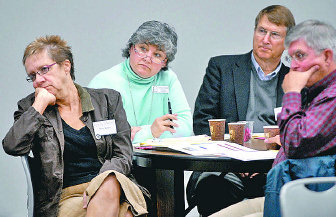
The 70 participants had assigned seating, so each table had representation of diverse viewpoints.
Table No. 7, for example, included two representatives from neighborhood groups, a county planner, an investor, a state lawmaker and a developer.
Their first assignment was to discuss fears and hopes regarding growth in Kootenai County – a conversation that began with traffic woes and ended with questions about whether the county commission has both the money and the staff to take the lead on crafting a vision for the area.
Tony Berns, executive director of Coeur d’Alene’s urban renewal agency and chairman of the chamber’s natural resources committee, said he was disappointed more elected officials, especially mayors and county commissioners, didn’t attend.
Berns plans to send the officials a summary highlighting the ideas that came from the gathering.