
Women in Civil War reenactment no act

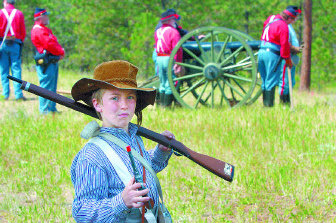
To prepare for battle, the soldier loaded her musket and donned a uniform.
Debbie Dunn also wore a fake mustache.
Like several other women at Riverside State Park Saturday, Dunn fought alongside the men at the Battle of Spokane Falls, the eighth annual Civil War reenactment sponsored by the Washington Civil War Association.
Known by her great-great grandfather’s name – David S. Parker, who was wounded in a wheat field during the Battle of Gettysburg – Dunn was shot down by a Confederate soldier before the skirmish ended Saturday morning. Her injuries, it turned out, weren’t serious; so she got up and fought again in the afternoon.
Although her persona for the reenactment was that of a male soldier from the 76th Regiment, Pennsylvania Volunteer Infantry, Dunn’s participation replicated a fact that’s not often recorded in history books: Women actually served as soldiers during the American Civil War.
“I’m constantly amazed at the strength of these women,” said Dunn, a Rupert, Idaho, resident and a history buff who has been involved in Civil War reenactments for the last 11 years. “They had the courage to do something that people thought women couldn’t do.”
It was against the law for women to join the military, so many worked as nurses or cooks and did odd jobs like laundry in order to help the men on the battlefield. But some women – at least 400, according to several Civil War Web sites – were able to disguise themselves as young men so they could join their brothers, fathers, husbands and other loved ones in the war.
“They had the same patriotic feelings but didn’t have the same opportunities to express it,” said Cosette Shiner of Bellingham, an artillery member of the Confederate Marines during this weekend’s reenactment.
Shiner and other members of the Washington Civil War Association pointed to the example of Sarah Emma Edmonds, who enlisted as Franklin Thompson in a Michigan infantry company. She participated in many battles including Antietam and Fredericksburg and successfully served as a spy.
It was rare for women’s perspectives to be included in official documents, said Shiner, but their stories survived thanks to the diaries they kept and the letters they sent home. Often, these journals described the fears and sorrows that men often didn’t talk about, she said.
“Women played a huge role – they were the mothers of the war because they took care of everyone,” said Darna Michie of Clayton, Wash., who resembled a Southern belle with her fancy hat, lacey parasol and elaborate hoopskirt gown as she watched the battle unfold in Riverside State Park.
Few teachers have the opportunity to teach their students about the contributions of women during the Civil War, let alone discuss of the most significant events in American history, Shiner said.
That’s why in addition to Civil War reenactments, the 800 or so families who belong to the Washington Civil War Association also take part in school programs and recruiting drives. The nonprofit organization is “committed to honor our ancestors, both North and South, who fought in or lived during the American Civil War,” according to its Web site.
“The Civil War is such a great story – there’s valor, pain, suffering, joy,” said Peter Jensen, the announcer at the reenactment who has been a Civil War buff for more than 60 years. “This event belongs to everyone.”
Many of the regulars at the Spokane reenactment describe their weekends as “a gathering of family,” albeit one with hundreds of members. It’s a hobby that brings together people of all ages and backgrounds, they said. It also has deepened their understanding and appreciation of history.
On Saturday, women who participated in the reenactment not only dressed up in period costume as they watched the battle amid all the smoke and loud gunfire; some also wore the thick, wool uniforms of both the Union and Confederate armies and fought alongside the men in the cavalry, artillery and infantry units.
“I just wanted to experience a soldier’s life,” said Amanda Nield of Elk, Wash., who rode her horse, Wind, with the 14th Regiment, Virginia Cavalry.
Like other women on the battlefield, Nield has two personas for the weekend. When she’s riding the horse in uniform, she’s known as Justin Dressen. In the evenings, when she puts on her fancy gown, she become’s Justin’s twin sister, Lily.
Along with Jana Conner, another cavalry member from Cheney, Nield has established a reputation for riding and shooting abilities. And unlike members of the infantry and artillery who fire their muskets on the ground, the soldiers on horseback rarely die during reenactments.
“I’ve learned a lot about the Civil War,” she said. “I’ve learned about how they lived, how they died and how they fought.”