
Despite loss of 3 limbs, woman becoming doctor

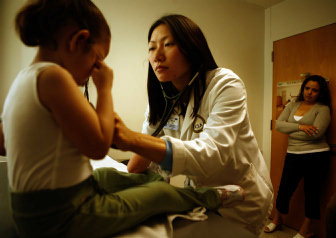
LOS ANGELES – Kellie Lim knows all too well what it is like to be a very sick child.
Struck with a ravaging bacterial infection that destroys limbs, she became a triple amputee at age 8 and faced a life of prosthetics, wheelchairs and often-painful rehabilitation.
But from that suffering, Lim forged a life of achievement. On Friday, she will graduate from medical school at the University of California, Los Angeles, and then will begin a residency program at the medical center there.
Her chosen specialty? Pediatrics, with a possible concentration later on childhood allergies and infectious diseases.
“Just having that experience of being someone so sick and how devastating that can be – not just for me but for my family, too – gives me a perspective that other people don’t necessarily have,” the 26-year-old Michigan native said recently.
Of all the topics she sampled during medical school, only her work with children left her “smiling at the end of the day.”
Lim carried out her medical training with a determination that awed her professors and fellow students and won her the school’s top prize for excellence in pediatrics.
Choosing not to use a prosthetic arm, she showed that she could perform most medical procedures with one hand, including taking blood and administering injections. She lives on her own in an apartment with no special features for the handicapped and drives a car with only one adaptation: a turning knob on the steering wheel. She is learning to swim, is trying horseback riding and even went tandem skydiving recently.
Lim, whose legs were amputated about 6 inches below her knees, gave up her wheelchair years ago and walks so well down the crowded hospital hallways that new classmates and patients often don’t have a clue for weeks that artificial limbs fill her shoes.
“With Kellie, at first you notice her hand is not there. But after about five minutes, she is so comfortable and so competent that you take her at face value and don’t ask questions so much. She has an aura of competence about her that you don’t worry,” said Dr. Elijah Wasson, who supervised Lim’s rotation in internal medicine at Olive View-UCLA Medical Center.
Lim attributes some of her gumption to her childhood bout with bacterial meningitis. The resulting toxic shock, with internal clotting and bleeding, wrecked her extremities, leading to the amputations. She had an 85 percent chance of dying.
Just five months after she became sick, Lim returned to regular school in suburban Detroit.
Previously right-handed, she learned to write and do chores mainly with her somewhat diminished left hand, which lost three fingertips to amputation along with her entire right hand and forearm. She has been fitted with prosthetic arms but does not wear one in public and uses it at home only rarely.
“I hate failing,” she said. “It’s one of those things that’s so ingrained in me.”
That view was intensified by another disability in the family. Her mother, Sandy, went blind in her 20s and, except for not driving, sought to continue as normal a life as possible in raising three children. She cooked, cleaned and walked the youngsters to school.
“She definitely was a great role model for me,” Lim said. “It was hard for her to overcome her blindness, and I think she definitely instilled a strength in me.”
Just before her mother’s death three years ago, Lim promised her that she would finish medical school – a pledge she will fulfill when she and her UCLA classmates take the Hippocratic oath.
“She wanted me to be a pediatrician,” Lim said, “and I know that somewhere out there, she knows I am going to be one.”