
Farmers work to save soil

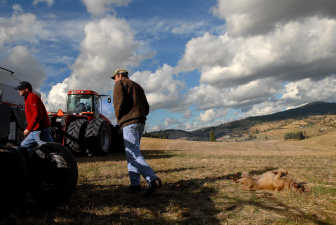
To make a point about soil conservation, Randy Emtman steered his pickup across a wheat field near Valleyford in south Spokane County, where soil loss 30 years ago had left a drainage trench deep enough to leave the field impassable.
The field has long since healed, and the soil is stable because the Emtman family switched to no-till farming practices and stopped using plows in the 1980s.
Today, the 10,000-acre Emtman Bros. Farms uses a 30-foot cross-slot drill to plant seeds and fertilizer into tiny parallel openings cut into the soil. The seed beds are tamped back down by trailing wheels on each slot device, leaving the field virtually undisturbed.
The Emtmans are among a newer breed of farmers with four-year college degrees and a willingness to invest in new, more powerful equipment that saves money and the environment.
In addition to growing grain, the Emtmans also raise a special Piedmontese breed of beef cattle that is lower in fat and cholesterol than other types of beef. The cattle graze larger pastures and are fed no antibiotics, growth hormones or steroids.
The Emtmans are selling the beef directly to the public through an outlet at their farm on South Weger Road.
Earlier this year, the Emtmans received the Vim Wright Stewardship Farm of the Year award for their progressive farming practices that reduce soil erosion and cut fuel and fertilizer bills dramatically. The award came from an organization known as Farming and the Environment, which promotes environmentally friendly agricultural practices.
Farming runs deep in the Emtman family.
John Emtman, an immigrant from Germany and the Emtmans’ great-grandfather, homesteaded the farm in 1887. He was followed by his son, Roy, who was followed by Roy Jr., who now has turned over most of the operations to his sons, Jeff and Randy.
“I guess it’s just something that’s built into the family,” said Jeff Emtman, who holds a 1992 Bachelor of Science degree in agricultural economics from Washington State University. “I like farming.”
Randy Emtman has a 1985 Bachelor of Science degree in agricultural mechanization, also from WSU.
The Emtmans’ two sisters – Debbie Campbell and Sharon Trumble – live nearby. All of them have homes around the farm.
Spokane County Conservation District officials point to the Emtmans as an example of how working the land and protecting the environment can go hand-in-hand.
“The Emtmans are highly regarded by the farming and environmental communities for their leadership in the application of conservation technology and techniques,” the conservation district said in its recent newsletter announcing the award.
Direct seeding causes minimal disturbance of the soil that “virtually stops all soil erosion from water and wind,” the newsletter said. “Conventional tillage practices can lead to the loss of seven to eight tons of soil per acre per year.”
Jim Armstrong, of the conservation district, said the Emtmans have proven that conservation pays. While direct seeding requires about four passes to prepare and harvest a crop, conventional tillage requires up to seven additional passes.
The Emtmans save about 70 percent on their fuel bills, he said.
It takes about 2 gallons of fuel for deep tilling a single acre. Rather than till, the Emtmans leave several inches of stubble, which helps retain soil moisture and keeps weeds under control.
Having the right amount of residue is a key to making the no-till system work.
“It makes a real nice condition for that seed to germinate and grow,” Randy Emtman said.
Soil erosion has been a serious problem on the Palouse’s hilly fields for years. Soil has clogged Latah Creek and the Spokane River at Nine Mile Falls Dam as well as Lake Spokane.
Sediment from Palouse farms is considered a potential pollution problem because the soil may be releasing damaging phosphorus into the waterways.
While the cost of upgrading to a cross-slot drill is about $100,000 for the Emtmans, the amount of money saved each year would pay for the upgrade quickly, the Emtmans said. However, it also takes a more powerful tractor with about 430 horsepower to pull the cross-slot drill and a related piece of planting equipment known as a shank drill.
The Emtmans also use high-tech global positioning systems to guide their tractors on precise routes across the fields. The auto-steer GPS systems eliminate any chance of overlapping passes, saving an additional 10 to 20 percent on fuel and product costs.
Also, they are using a radar gun system to control liquid fertilizer applications.
“Sometimes you have to spend money to make money,” Randy Emtman said.
Jeff Emtman said farmers need to look beyond the cost of the equipment upgrades.
“They are not looking at the part of what it can save you,” he said.
Armstrong, who serves on the board of directors for Farming and the Environment, said the Emtmans are way ahead of most farmers in conservation practices.
“They are absolutely setting the bar for agriculture in the Northwest,” he said.