
Always on guard
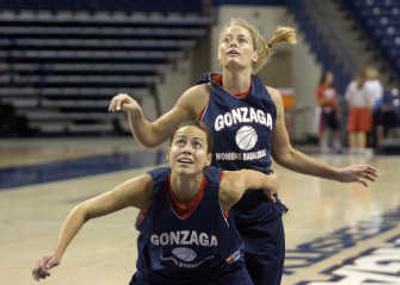
For a region that produces some of the best high school girls basketball players in the Northwest, the four Division I women’s team in the area, as a group, could best be described as average.
Or worse.
Last season Gonzaga completed a grand slam for the Inland Northwest, joining Washington State (1991), Eastern Washington (1987) and Idaho (1985) in finally qualifying for the NCAA tournament. But while the Bulldogs (24-10 overall) were building a 13-1 record and winning the West Coast Conference, the Cougars, Eagles and Vandals were a combined 9-41 in the Pac-10, Big Sky and West Coast conferences, respectively.
It wasn’t long ago (2004-05) when GU, EWU and UI all had winning records, but that’s just the second time that three of the four area teams were in the black in the same season as Division I members.
The Bulldogs, who have become dominant in the WCC in recent years, are poised to make another run. Wendy Schuller of EWU and Mike Divilbiss of Idaho are rebuilding after going 10-19 and 6-22, respectively, their worst records in their six years at their school. Meanwhile, the Cougars, 5-24 in Sherri Murrell’s last year, are starting over under former Washington coach June Daugherty.
Making the NCAA tournament, which stops in Spokane in March for the West Regional final, isn’t the only criteria for success, but it is what all teams desire. To be included, Gonzaga, Eastern and Idaho generally have to win their conference’s automatic berth and WSU has to be in the top half of the powerful Pac-10.
To grab that elusive invitation to March Madness, three of the coaches said the first step is finding a solid point guard.
“The college game is dictated by guard play,” Divilbiss said. “You can win with undersized post players and great guard play. You can’t win with no guard play and good big kids. No way.”
Before moving into the WAC two years ago, Idaho was battling Santa Barbara for the supremacy in the Big West Conference with overachieving 5-foot-11 scoring machine Emily Faurholt at center. Gonzaga has gone 38-4 in the WCC over the last three years, 57-13 over five, with short and/or slender posts more suited to play forward. Eastern played in the Big Sky tournament in each of Schuller’s first five years because of solid post play but failed to parlay that into an appearance in the title game with the NCAA berth on the line.
“We’re not very big. For conference play we’re fine, (but) you need point guards,” Graves said. “We’ve never had the biggest kids in the conference. Even when we’ve had tall kids, they weren’t the biggest or strongest. We want to take that next step now. You have to have legitimate post kids … those big kids.”
“I think the biggest thing has been guard play,” Schuller said. “If you go back the last six years we’ve had an all-conference post player every year. … Our post play is good. It’s where it needed to be. Our guard play hasn’t been superb when you look at the other teams in the league.
“The kids we’ve had were talented for sure, but it’s a whole package deal. Talent alone isn’t what it’s all about.”
Daugherty, who had a record of 191-139 and six appearances in the NCAA tournament in 11 seasons with the Huskies, preferred to focus on the task at hand, teaching her new team a new system rather than speculating how and when the Cougars might become more competitive.
There are several reasons why it is difficult to find the elite level point guard capable of elevating a team to the level of being a conference contender.
“I think it’s hard to find just the right kid to play the point,” Schuller said. “That’s your quarterback, somebody that has to believe in the coach, the coaching staff and the system and then be somebody who’s willing to step up and lead the team.
“Sometimes that means stepping on toes, sometimes it means putting arm around them. … That’s a tough weight to bear.”
“In the Northwest, point guards with the athletic ability to play in the WAC – there aren’t many,” Divilbiss said. “It’s not just the four of us – there’s Washington, Oregon and Oregon State. Then the California schools, Arizona State, come up to recruit.”
Mix in recruiting to Pullman, Moscow, Cheney and Spokane with some top players drawn to the bright lights and warm temperatures of the invading recruiters, and it gets tough.
The common word the coaches used to overcome location was relationships.
“We sell a quality education, a basketball program that is going to develop you and a basketball team with great chemistry,” Divilbiss said. “We don’t sell … the fluff. We don’t have fluff. What we have is meat and potatoes and confidence in what we’re doing.”
A key is not selling yourself short.
“What we’re doing, and what Kelly is doing, is recruiting Pac-10 kids,” Divilbiss said. “If you get those kids, you can get other kids.”
“You can get that player, then that group of young players, and let them grow up,” Graves said. “Then they graduate and you have to do it again. You have to consistently bring in that top level of recruit year in and year out. We’re starting to. We’re using the model our men are. That’s what has set us apart from the rest of the league.”