
Expert says Russell wasn’t speeding

KELSO, Wash. – Despite what the prosecution says, Fred Russell was not sailing through the night at 90 mph when he triggered a multi-car wreck that killed three people, an accident-reconstruction expert testified Thursday.
“The speed of (Russell’s) Blazer was 66 or 67 mph,” said Richard Chapman, a retired Seattle police officer who is now an accident consultant.
Chapman was brought in by Russell’s defense team, which is arguing that the 2001 chain-reaction crash was an accident, not a crime. Prosecutors say that Russell was drunk, speeding and passing in a no-passing zone.
After three weeks, the trial could go to the jury today. Both sides are hoping to get to opening arguments this afternoon, after one final witness for the prosecution.
In a lecture-style presentation laced with technical jargon, Chapman spent more than two hours Thursday walking jurors through what happened in the crash. He talked about the vehicles’ “maximum engagement,” yaw, “energy-equivalent speed loss,” deceleration, area of impact, drag factors and a long string of equations to determine how fast each vehicle was struck. Earlier in the trial, Washington State Patrol accident investigators concluded that there was no way to accurately estimate Russell’s speed.
Chapman – who charges $180 an hour – also cast doubt on driver Robert Hart’s account that Russell came up quickly on his bumper the night of the crash. Hart testified that he pulled over to let Russell pass, lost sight of the car, then saw the crash. Earlier in the trial, defense attorneys implied that Hart pulled back onto the road too quickly, forcing Russell partly into the oncoming lane. Hart denies that.
Russell’s lawyers also say the reason he fled shortly before trial in 2001 was fear for his life, not a desire to dodge responsibility for the crash. Russell fled to Canada and then to Ireland, where he was living, working and had a girlfriend when he was apprehended last year.
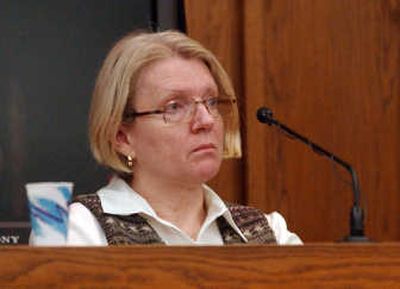
“He was just so scared,” Russell’s mother, Linda Wilms Russell, told jurors.
She and a longtime family friend testified that Russell and family members were badly shaken by a series of threats as he awaited trial in fall 2001. When she flew in from California shortly after the June 4 crash, friends told her not to check into a Pullman hotel under her own name, she said. She eventually got a concealed weapons permit.
When her son disappeared in October, she testified, she thought he’d been murdered.
“I absolutely thought that he was dead, that somebody had killed him and that nobody cared,” she said.
Family friend Kathleen Siemont told jurors that the former Washington State University student and his father were “white as a sheet” when someone slipped a death threat under the doormat of the Pullman town house they shared in 2001. She was visiting at the time.
“Fred, you won’t live to see trial,” the note read.
“He was just constantly watching his back,” said Siemont, now a California attorney.
Defense attorneys also played for the jury a recorded phone message left on at the Russells’ apartment phone.
“You’re going to go to prison for a long time, you worthless (person),” the expletive-laden recording begins. A male voice, speaking slowly , says “… I hope and I pray to God that you get raped in prison. … I hope someone puts a … bullet in your head … and I’m going to be laughing all the way. … You’re a killer, you’re a … drunk … who kills people. … Enjoy your time in prison.” The recording also threatens Russell’s mother.
Russell, as he has throughout the trial, showed little emotion Thursday morning. He’s been watching witnesses – including his mother – intently, frequently whispering to his attorneys.
Russell’s mother and Siemont both criticized press coverage of the case. It was the intense coverage over the six years since the crash that led Whitman County Superior Court Judge David Frazier to move the trial from Colfax across the state to rural Cowlitz County, about 40 minutes north of Portland.