
Forever changed by war
WASHINGTON – Even now, the sound of a helicopter or a phrase of Vietnamese can carry Len Funk back to the war. Mike Kentes still sits in a bar or restaurant where he can keep an eye on the door. And years after Hugh Jordan would sleep through the roar of outgoing artillery, his ears still ring from the thunder of the heavy guns.
Twenty-five years ago, the three men were young and proud as they attended the dedication of the Vietnam Veterans Memorial, marching in berets and fatigues only a decade or so removed from the battlefield and basking in the applause.
This week, thousands like them are again gathering in Washington, this time to observe the 25th anniversary of the Wall, as it is widely known. A downtown parade and other activities are scheduled for Saturday, and commemorative ceremonies will be held at the Wall on Sunday.
But now the men and women of the Vietnam War era are aging and gray and more than 30 years removed from the conflict. Many have jobs near the top of their fields, and, numbering 7.2 million, they make up the nation’s largest veterans group. Seventeen of them sit in Congress.
They have clout and respect, and the old fatigue jacket now is often worn mostly for yardwork.
Yet, despite the passing of time and the veterans’ ascent to mainstream wealth and status, the war remains strongly with them, marking them and separating them, as war does with most who experience it.
In recent interviews, Kentes, 59, Jordan, 61, and Funk, 65, said the war is a vital part of who they are. It helped define them, they said, mostly for the better. It continues to do so as they mark this milestone, they said, and probably will forever.
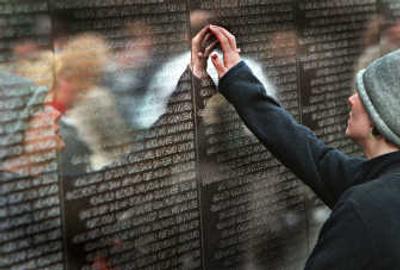
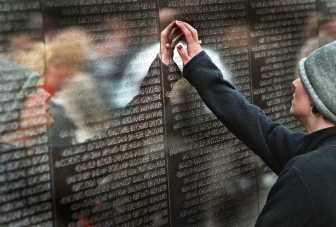
Mike Kentes was looking for the names of two buddies that chilly November weekend a quarter-century ago when he was photographed in his dark beret and camo jacket holding a red carnation reflected in the gleaming wall.
He was 34 and handsome, with gray-flecked dark hair and a dark mustache. The photograph would later run on the cover of National Geographic.
It was 1982, and several hundred thousand people had gathered for the wall’s Nov. 13 dedication.
That weekend, Kentes, of Falls Church, Va., was reconnecting with a firefight in the Mekong Delta 13 years before. It was Memorial Day 1969, he recalled, when he saw two buddies, Curtis Daniels and Michael Volheim, killed.
Kentes and five other Army Rangers were chasing enemy soldiers when Daniels and Volheim were cut down by gunfire. Kentes and two others counterattacked to retrieve their comrades’ bodies, and Kentes believes he killed two enemy soldiers in the process. It was the first of many such encounters, he said.
Sipping coffee and smoking a thin cigar in a Falls Church restaurant last week, Kentes said he did not keep track of how many enemy soldiers he killed in Vietnam.
But there was pride in victory. When he and his fellow Rangers staged a successful ambush, it was: “You screwed up, and we didn’t.” In combat, “you get hardened,” he said, “you get real, real hardened.”
He was unemployed in November 1982, with a wife and a 6-month-old son, and had not put the war behind him. “I thought about it every day,” he said. “Still do.”
Vietnam veterans had been called whiners and losers by older veterans, and fools or worse by people of their own generation, Kentes said.
But now here was the Wall. “It was like being back in Vietnam, having all the guys there,” he said. “In fact, the hardest part of the whole thing was that Monday, when everybody left. I mean, I just got really depressed.”
Since then, he said, life has had ups and downs. He and his wife had another son, then divorced seven years ago. “I’m quite sure the Vietnam experience had something to do with that,” he said.
‘I wasn’t a coward’
When Hugh M. Jordan showed up at Washington’s Shoreham Hotel for pre-dedication festivities that weekend in 1982, he could find no gathering place for the outfit in which he had served in Vietnam, the Americal Division.
Other units had hospitality suites. But the Americal, formed in the South Pacific during World War II, didn’t even have a table. So he and some friends commandeered a desk. One man ripped the sky-blue division patch from his old uniform and pinned it on a poster board.
They started collecting donations in a shoebox, got enough money to rent a hospitality suite and stock it with beer, and soon had a regular reunion going, just like the other outfits.
Jordan, of Great Falls, Va., had landed in the Americal Division in 1968. The year before, he and his best friend, Gerald Niewenhous, entered the Army to become helicopter pilots.
But Jordan’s eyesight wasn’t good enough, and he was assigned to the artillery. He was disappointed, because his friend was cleared to stay with helicopters.
Jordan went to Vietnam that September and wound up with a battery on Hill 54 near a town called Tam Ky. One night, right after he arrived, the hill was attacked. Jordan was sent out to the perimeter to help. He exchanged fire with the enemy and found two dead Americans in a bunker.
He was 22, and his biggest fear was not that he might be killed but that he might screw up: “Would I be a coward? Would I stand up when the time came?” he said.
The battle ended with daylight, and it was not until he returned to his battery that his knees started to shake. But he said to himself: “I survived, and I wasn’t a coward.”
‘It’s always there’
Len Funk was on a business trip to Washington that weekend in 1982. He had been in the international moving industry for many years after the war and was moving to New York from Portugal. His wife, who was expecting their first child, urged him to stay and attend the ceremonies.
Vietnam once had been a big part of Funk’s life. He had served there as an Army adviser for 20 months in 1969 and 1970 and went back in 1972 for 30 months as a State Department employee, he said in an interview at his home in Arlington, Va.
He learned to speak Vietnamese and came to abhor the war’s destruction. He admired the country’s people: “Their life and their struggle really sunk in,” he said. And he watched some of the war’s final scenes as the North Vietnamese closed in and the United States withdrew.
Funk left in December 1974 – four months before Saigon fell – disillusioned, cynical and realizing he needed to move on. “I’ve been invested in this,” he said he thought. “How long can you believe, or try to believe, in something?”
Eight years later, the Washington hotels were filled with veterans like him.
“It was the first time we felt we could talk about this,” he said. “It was the first gathering, kind of. … It was, ‘OK, we can talk openly about this. We don’t have to be ashamed of it.’ “
Now, 25 years on, being a Vietnam veteran has “cachet,” he said.
He believes the experience defined him, making him a better person and vehemently anti-war.
And to this day, if he hears a helicopter or the Vietnamese language, it all comes back.
“It’s always there,” he said. “Vietnam never leaves you.”