
Bellevue boy comes to rescue of baby sister
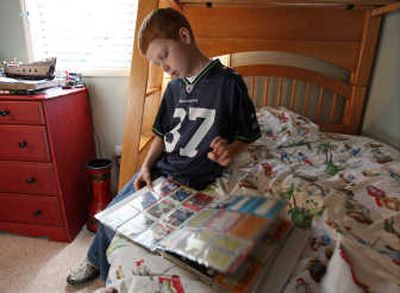
BELLEVUE, Wash. – At 9 years old, Sam Calhoun has come to understand this: Sometimes, bad things just happen.
Like when you’re picked last for a team. Or when you get stuck on level one of a Nintendo Wii game.
But something really bad? That would be like when his baby sister got sick. After Claire was born in 2005, she spent days, even weeks, at the hospital. Sam watched his mom cry, and then his dad, who’s a really big guy, by the way. They said Claire needed new bone marrow or she would die.
Then they told Sam something else.
They said he could be the one to help save her.
This is what Sam remembers of Oct. 12, the day he went to Children’s Hospital & Regional Medical Center in Seattle to donate bone marrow to his sister:
“I wasn’t scared. I wore a blanket around me like a superhero cape. And I got all these gifts, like this Shaun Alexander jersey. He’s, like, the best running back ever. And I also got a Wii with some new games that my dad bought, and I got a Spiderman balloon. I used that as a punching bag like this, ‘Pow!’ “
Unless Sam shows you the twin marks on his lower back, where doctors extracted marrow from his pelvic bone, there are no signs the Issaquah boy underwent the procedure.
He has bright brown eyes, strawberry hair and a smile that shows off a gap in his front teeth. He’s back in the third-grade at Sunset Elementary in Bellevue and riding bikes again with his neighbors. He wore a Lego Bionicle costume for Halloween, which happens to be his birthday.
Here’s how Sam explains his surgery:
“Bone marrow fights off, like, germs and stuff that can make you really sick, sort of like an army. My grandpa said I was a general, and I had to give over a billion blood cells to Claire, so it could help Claire’s army, so Claire would be better. I knew if I didn’t help Claire, she would probably be really sick and be dying, maybe. And I didn’t want her to die, so I went to the hospital.”
Bone marrow is the spongy tissue inside bones. It’s critical soil in which blood cells grow.
Claire’s bone marrow doesn’t make red blood cells. Doctors discovered this six weeks after she was born, and the cause remains elusive. Leukemia was ruled out. Scores of tests have yielded no concrete answers, said her mother, Debbie Calhoun.
Claire, who is also developmentally delayed, grew dependent on regular blood transfusions to survive. But in time, her body began to reject this, too. She broke into fevers and hives. Her airway closed, and her white blood cell count plummeted.
A bone marrow transplant offered a sliver of hope.
More than 16,000 transplants are done a year, according to the Center for International Blood and Marrow Transplant Research in Milwaukee, Wis. Last year, 455 were performed through the Seattle Cancer Care Alliance. Of the 49 children who underwent transplants, 11 had sibling donors.
Risks to donors are minimal and the procedure causes no more than soreness, doctors say. Patients are given general anesthesia and are discharged the same day, said Dr. Jean Sanders, director of bone marrow transplantation service at Children’s.
The procedure can be done on anyone, even babies, she said. Parents ultimately must consent for a minor.
Still, transplants offer no guarantee. And given Claire’s web of medical issues, her odds were shakier. She’d have to undergo intense chemotherapy to destroy her bone marrow, killing what little defenses she had left. Then doctors would infuse healthy marrow into her bloodstream. If all went well, the new bone marrow would migrate inside her bone cavities and start producing normal blood cells.
First, she needed a donor. There’s a 30 percent chance one will be found among relatives, according to the research center.
So last September, the Calhouns were tested. Debbie; her husband, Mike; and sons Sam and Braeden, 11. The procedure searches for 10 blood markers. Sam’s returned a perfect match.
Debbie and Mike didn’t tell their son until months later. Transplant was a last resort. But as Claire’s health continued to spiral, it became their only choice. So one day in June, she and Mike sat the boys down.
Debbie: “We said, ‘You know that Claire is sick. She needs to go through what’s called a bone marrow transplant so she can live. Remember when we went and had our blood taken? And they were looking for the right match? Can you guess who was the match? This person has the same color hair as Claire.’ “
She blinks, but the tears fall anyway.
“We said, ‘Sam, it’s you,’ and Sam said, ‘I don’t want to give Claire my bones.’ “
They explained that he didn’t have to give his bones, just the marrow inside and it would grow again. He was being asked to do an important thing for Claire, they told him.
“We were all crying. And then he said, ‘OK, I’ll do it. If that’s what Claire needs.’ “
Later, he showed the doctors the best vein he’d picked for them to poke.
Sam remembers the day Claire was born, all pink and small with tufts of red hair. Everyone said they looked alike. And if he peered closely enough, he could see the resemblance, too.
He had become a big brother. Finally, he could be the older one. Braeden no longer held this sacred perch to himself.
As Claire got sicker and sicker, Sam always knew what to do. He’d clasp her hands and kiss her fingers until she dissolved into giggles. It didn’t matter if she’d just come from the hospital, sore and hot and cranky. The trick worked every time.
Claire is nearly four weeks into the transplant, and doctors are watching her closely. She’s had some minor setbacks, including a recent trip to the intensive-care unit for respiratory distress, said Dr. Monica Thakar, Claire’s primary hematologist at Children’s. But overall, her white cell counts are up, and this week, her body showed signs of forming its own red blood cells.
“Sam’s marrow seems to be finding a home in Claire,” Thakar said.
For now, Sam’s army continues to fight. But it will be a long war.
If his crew falters, and the enemy returns, Sam will be ready to re-enter combat. He’s not afraid to donate again, he says. It didn’t hurt that much, anyway.
Besides, a good general never lets down his troops.