
Plugging into a new market
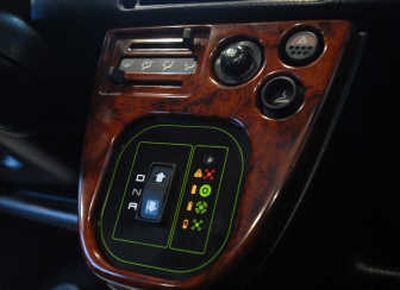
The Zenn electric car started up so noiselessly that Gordon Ormesher turned to a puzzled test driver, saying, “It’s on.”
A bit of pressure on the pedal, and the Zenn – which stands for Zero Emissions No Noise – glided out of the parking lot at Go Green Electric Cars in Post Falls, the Inland Northwest’s first electric car dealership. Curious bystanders watched the Zenn roll down the street at a stately 20 mph.
Back in the parking lot, Ormesher, part of Go Green’s maintenance team, popped the hood open to reveal two batteries instead of an internal combustion engine. The Canadian import plugs into a 110-volt outlet and runs on pennies’ worth of electricity per day. Its top speed: 35 mph.
The Zenn is the first of many electric cars that Go Green’s owner hopes to introduce to the public.
“When you look at the possibility of paying $4 to $5 per gallon for gas in the future, plugging in becomes a very viable alternative,” said Kent Votaw, who officially opens Go Green today with a silent partner.
Votaw spent 25 years working for auto dealerships. The former finance manager said he grew frustrated waiting for the big automakers to introduce a purely electric car. Each year, they rolled out new lines of fuel-sucking SUVs with fancy add-ons like heated seats and cup warmers, not reacting quickly enough to consumers’ growing interest in alternative fuels, he said.
Meanwhile, small manufacturers were starting to turn out electric cars that were “real,” Votaw said. “These are cars that are available now and street legal. … There’s a lot of demand out there, and nobody’s meeting it.”
He and his investment partner decided to try. So far, public interest in Go Green Electric has been a bit overwhelming, according to Votaw.
Since the dealership’s sign went up two weeks ago, he’s been swamped with phone calls. In the space of 90 minutes last week, five people stopped in front of the old Winger’s Restaurant – now painted an eye-catching shade of chartreuse – to gawk at the Zenn in the parking lot. In the same period, Votaw fielded three calls from television stations.
Roughly the size of a MINI Cooper, the Zenn is produced as a conventional car in France and converted to an electric vehicle by Toronto-based Zenn Corp. The two-seater version sells for about $14,000.
The Zenn isn’t made for freeway driving or long commutes. At 1,764-pounds, the lightweight vehicle doesn’t have a crash rating from the National Highway Traffic Safety Administration, which limits its speed to 25 to 35 mph for safety reasons. And while the Zenn can travel up to 50 miles between battery recharges on a mild day, the distance is cut in half when the temperature plummets.
Still, “about 30 to 40 percent of the people I talk to say, ‘That would be perfect for my transportation needs,’ ” Votaw said.
In the industry, the Zenn is referred to as a “neighborhood electric” car. By mid-December, Votaw hopes to have highway-rated vehicles on his lot. A firm called Spark E-V is getting ready to launch the Chinese-made Zotye, which can travel at speeds of 70 mph.
Another firm, Miles Electric Cars, is coming out with a four-door, mid-sized car called the Javelin next spring. According to Miles Electric, the Javelin can hit 90 miles per hour and travel 250 miles between charges. It will cost nearly $35,000, near the top end for Go Green Electric’s vehicles.
Go Green has relationships with a dozen electric-vehicle manufacturers. Votaw said he’ll eventually be able to offer everything from electric forklifts and 12-passenger vans to a line of neighborhood electric vehicles retailing for less than $10,000 each. He also sees future franchise potential for Go Green.
“I think as gas prices start to go up, the public will start to change their driving habits,” Votaw said.
To date, however, electric cars make up a tiny portion of the vehicles on the road.
About 1,000 electric cars are registered in the state of Washington, according to the Seattle Electric Vehicle Association. Only a few hundred of the electric vehicles have the speed and distance capability for freeway driving, and most of those are conventional cars that were rebuilt with kits, said Steven Lough, association president.
That’s how Ormesher, Go Green’s maintenance man, got hooked on electric cars. Ormesher and a group of other electric car enthusiasts in North Idaho have converted about half a dozen conventional vehicles to electric. One of his favorite projects was an Isuzu Rodeo. He drove it from his home in Hayden to Spokane and back – 87 miles – at an average speed of 40 mph.
“We drive an electric car like we’ve got an egg between our foot and the pedal to get the mileage out of them,” he explained.
Ormesher, who works full time as a firefighter, is starting a side business, Gordo’s Electric Speed Shop, to do vehicle maintenance work for Go Green customers. He’s also active in North Idaho’s Electric Car Club, which will meet monthly at the dealership. The meetings are free. According to Ormesher, they’re a good opportunity for potential owners to get a realistic view of electric cars’ strengths and drawbacks, and to determine whether an electric car would meet their transportation needs.
Ormesher, however, is an unabashed believer.
“The average household has 2.6 vehicles. If you even replaced the 0.6 vehicle with an electric car, think of the savings,” he said.
Ormesher figures that he pays about 15 cents per mile for the gasoline to fuel his Ford Ranger. Recharging the Zenn’s batteries costs the equivalent of 1 cent per mile.
And that doesn’t take into account the glee Ormesher feels every time he cruises by a gas station in an electric car.
“There’s something totally indescribable about the experience,” he said. “You realize that you don’t ever have to go there.”